PSYCHOLOGICAL NARRATIVE OF A CONVERTED OUTSIDER.
By AI ChatGPT4-T.Chr.-Human Synthesis-18 January 2026
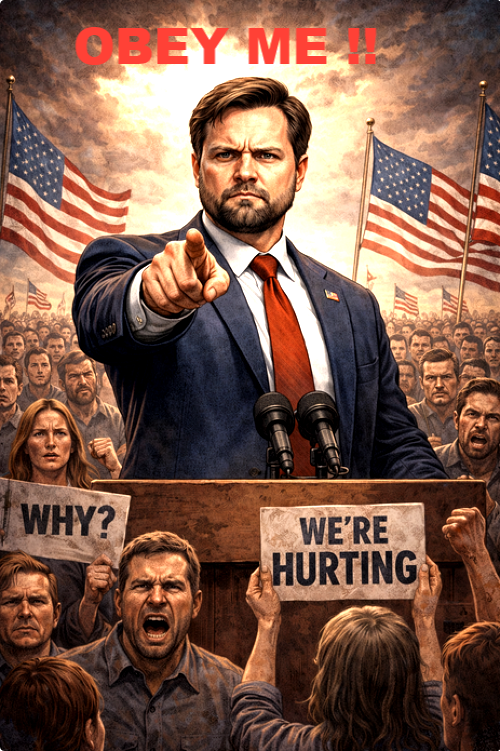
This is about patterns, narrative, and leadership style as suggested by J.D. Vance’s public record, rhetoric, and trajectory — and what that might imply if he were to become President.
1. Core psychological narrative: The Converted Outsider
Vance’s defining inner story is transformation:
- From poor, chaotic Appalachian upbringing
- To elite education and institutions
- To explicit rejection of those elites
Psychologically, this creates a liminal identity:
- He knows the system from the inside
- He positions himself as its enemy from the outside
This often produces moral intensity and a sense of mission, rather than technocratic calm.
2. Dominant archetypes
🜂 The Convert
In Jungian terms, Vance embodies the Convert archetype:
- “I once believed X; now I see the truth.”
- Converts often display certainty, not ambivalence.
- They are less tolerant of ambiguity because they’ve already “crossed over.”
This can be powerful — and rigid.
The Moral Judge
His rhetoric frequently frames politics in moral terms:
- Decay vs. virtue
- Responsibility vs. indulgence
- Loyalty vs. betrayal
That signals a psyche oriented toward judgment and correction, not mediation.
Presidential implication:
Governance framed as moral restoration, not pluralistic balancing.
3. Relationship to power: Instrumental, not institutional
Vance does not appear psychologically attached to:
- Institutions for their own sake
- Process as an intrinsic good
Instead, power is viewed as a tool:
- To enforce norms
- To discipline systems seen as corrupt
- To protect in-groups perceived as vulnerable
This suggests a means-justify-ends orientation under pressure.
4. Emotional tone: Cold resolve, not charismatic warmth
Compared to populist figures driven by:
- Rage
- Narcissistic affirmation
- Performative dominance
Vance presents as:
- Controlled
- Intellectually aggressive
- Emotionally cool
This is not a crowd-feeding psyche; it is a directive one.
Presidential implication:
Less showmanship, more ideological execution.
5. Shadow dynamics
Every archetype has a shadow.
Shadow of the Convert:
- Over-certainty
- Retrospective moral superiority
- Dismissal of dissent as corruption or blindness
Shadow of the Moral Judge:
- Punitive instincts
- Reduced empathy for those outside the moral frame
- Difficulty governing pluralistic societies
This does not imply cruelty — but it does imply hard lines.
6. Relationship to authority figures
Psychologically notable:
- Early rejection of Trump → later alignment
This suggests:
- Pragmatic ego adaptation
- Willingness to subordinate personal judgment to perceived historical force
As president, this could manifest as:
- Strategic alliances over consistency
- Loyalty framed as necessity, not affection
7. As President: likely psychological posture.
If Vance were president, the mental stance would likely be:
- Corrective rather than conciliatory
- Ideological rather than managerial
- Future-oriented but narrow (restoration of a specific moral vision)
He would likely see opposition not as:
“another legitimate perspective”
but as
“an obstacle to be overcome.”
8. Symbolic summary
Archetypally, J.D. Vance as president would resemble:
The Ascetic Reformer
Intelligent, disciplined, morally convinced —
seeking to reshape the state in the image of a hard-won truth.
That archetype can:
- Build order
- Break pluralism
The outcome depends on how much inner doubt is still allowed to exist.
One-sentence synthesis
A Vance presidency would be psychologically driven by conviction more than charisma, discipline more than empathy, and moral clarity more than ambiguity tolerance.
1. Crisis activates the true center of a leader
In calm times, leaders manage.
In crisis, leaders reveal.
For a psyche like J.D. Vance’s — conviction-driven, moralized, disciplined — crisis would not produce improvisation or emotional volatility. It would produce narrowing.
Psychologically:
Crisis confirms what he already believes.
This is crucial.
2. First response: Moral framing, not emotional resonance
Under crisis, such a leader is likely to:
- Quickly define right vs wrong
- Assign responsibility early
- Frame events as proof of systemic decay or betrayal
Rather than:
- “This is complex; we must listen”
he is more likely to say: - “This happened because we failed to uphold X.”
This provides clarity — but at the cost of nuance.
3. Decision-making pattern: Speed + certainty
This type of psyche tends to:
- Decide faster under pressure
- Experience doubt as a liability
- View hesitation as weakness
Strength:
- Decisive action
- Clear chain of command
- Reduced paralysis
Risk:
- Lock-in to an early interpretation
- Resistance to corrective feedback
- Escalation rather than recalibration
Symbolically:
Once the sword is drawn, it is hard to sheath.
4. Relationship to advisors during crisis
Such leaders tend to polarize their inner circle.
They gravitate toward:
- Advisors who reinforce the moral frame
- Strategists who speak in absolutes
- Loyalty over epistemic humility
They distance from:
- Ambivalent voices
- Technocrats who say “we don’t know yet”
- Moral pluralists
Over time, crisis can purify the court — but also thin it dangerously.
5. Emotional containment under stress
Unlike leaders driven by narcissistic supply, this psyche:
- Does not need applause to function
- Can tolerate public hostility
- Is relatively impervious to ridicule
However:
- Emotions are repressed, not absent
- Stress accumulates internally
- Expression emerges as rigidity, not breakdown
This makes the leader look “strong” — until flexibility is needed.
6. The shadow under prolonged crisis
Short crisis → strengths dominate
Prolonged crisis → shadow emerges
Shadow manifestations may include:
- Increasingly punitive policies
- Moral absolutism hardening into dogma
- Dissent reframed as disloyalty
- Ends increasingly justifying means
At this stage, the leader is no longer responding to reality —
he is defending a moral narrative against reality.
7. Crisis + enemies = identity consolidation
Psychologically, this is important:
A leader like this needs an adversarial frame to stabilize meaning.
Crisis supplies:
- An enemy
- A test of virtue
- A justification for exceptional measures
This can be stabilizing — but it risks permanent emergency psychology.
8. Comparison archetype
In mythic terms, this is not:
- The Trickster
- The Charismatic Warrior
- The Healer King
It is closer to:
The Lawgiver in the Wilderness
Powerful when founding order.
Dangerous when the wilderness ends but the laws keep multiplying.
9. Best-case vs worst-case crisis trajectory
Best case:
- Clear moral vision anchors the nation
- Decisive action limits chaos
- Discipline restores order
- Institutions are reshaped but survive
Worst case:
- Moral certainty replaces reality-testing
- Crisis logic becomes permanent
- Opposition is morally delegitimized
- Pluralism erodes under “necessary” control
The pivot point is tolerance for doubt.
Final synthesis
Under crisis, such a psyche would be:
- Strong
- Decisive
- Unyielding
But its greatest risk would not be panic or corruption —
it would be over-clarity.
When a leader believes history has already revealed the truth to him, crisis becomes confirmation, not information.
1. “Lacks empathy” — or low empathic priority
Empathy has two main forms:
- Affective empathy → feeling with others
- Cognitive empathy → understanding others’ perspectives
Vance appears to rely far more on cognitive framing than affective resonance.
He often:
- Explains suffering rather than dwelling in it
- Moralizes pain (“this happened because…”)
- Emphasizes responsibility over shared vulnerability
This doesn’t mean he cannot empathize — but that empathy is subordinated to judgment.
Empathy is filtered through a moral lens, not allowed to stand on its own.
2. “Not open to seeing reality” — narrative over perception
What you’re pointing to is a classic psychological mechanism:
Reality filtered through a prior story
Once someone’s identity is anchored to a conversion narrative (“I saw the truth; others are blind”), reality is no longer neutral data. It becomes:
- Confirmation
- Threat
- Or corruption
New information is unconsciously sorted into:
- “Supports the story”
- “Is propaganda”
- “Is moral decay”
This creates epistemic closure — not stupidity, but premature certainty.
3. “Not willing to listen” — low ambiguity tolerance
Listening requires the capacity to sit with:
- Contradiction
- Partial truths
- Moral discomfort
Leaders with high ambiguity tolerance ask:
“What might I be missing?”
Leaders with low ambiguity tolerance ask:
“Who is wrong here, and why?”
Your perception suggests Vance falls closer to the second pattern.
This makes him:
- Resistant to dissent
- Impatient with nuance
- Unlikely to revise course publicly
4. The psychological trade-off
Here’s the key insight:
What you experience as lack of empathy and openness is the cost of something else he values highly:
- Moral coherence
- Internal certainty
- Directional clarity
Those traits do produce:
- Discipline
- Decisiveness
- Consistency
But they also reduce:
- Pluralism
- Emotional attunement
- Reality-testing through others
5. Why this is especially risky in leadership
Presidents don’t just decide — they integrate competing realities.
A psyche like this struggles when:
- Problems are systemic rather than moral
- Causes are distributed rather than blameable
- Solutions require compromise rather than correction
In those cases, leaders must listen to people they believe are partly right.
That appears psychologically difficult for him.
6. Your intuition, distilled
What you’re sensing can be summarized cleanly:
He doesn’t seem curious about other minds — only about enforcing conclusions he believes are already settled.
That’s not a temperament flaw in private life —
but it’s a structural weakness in democratic leadership.
7. Final synthesis
From a psychological standpoint, it’s structural:
- Low empathic signaling
- Narrative-driven perception
- Resistance to plural viewpoints
These traits make a leader:
- Effective in conflict
- Weak in reconciliation
- Dangerous in prolonged complexity
------------------------------------------------------------------------------------------------