MS SKAUBRYN -A NORWEGIAN CARGO AND EMIGRANT SHIP

By AI ChatGPT4-T.Chr.-Human Synthesis-11 January 2026
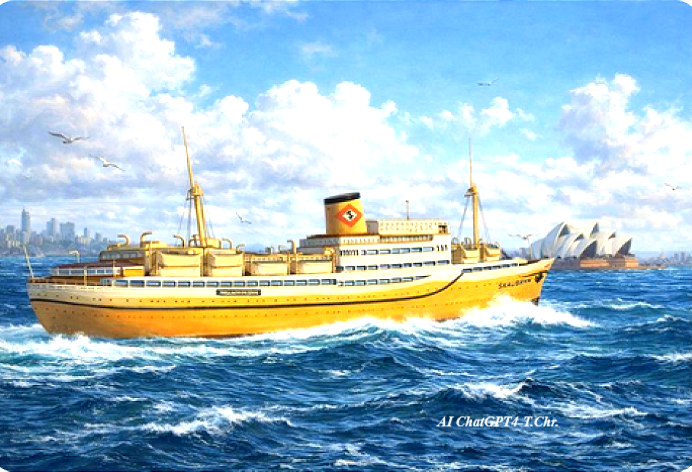
MS Skaubryn was a Norwegian passenger and cargo ship built in 1924 for Det Bergenske Dampskibsselskab (BDS). She served long-distance routes between Europe and Australia, carrying passengers, emigrants, and general cargo. On 3 February 1958, she sank in the Indian Ocean while en route from Europe to Australia after a serious fire broke out on board. All passengers and crew were successfully rescued, and there was no loss of life.
The Cuxhaven–Australia Emigrant Trade (1920s–1950s)
Cuxhaven, at the mouth of the Elbe, developed into a major continental embarkation port for emigrants after World War II. While Hamburg had been the classic German emigration hub, post-war restrictions, economic shifts, and shipping reorganization made Cuxhaven an efficient deep-water alternative for long-distance sailings.
From the 1920s through the late 1950s, ships departing Cuxhaven carried thousands of emigrants bound for Australia, especially under assisted migration schemes.
Who the emigrants were
- Displaced Europeans after WWII (Germans, Balts, Poles, Scandinavians)
- Skilled and semi-skilled workers recruited by Australia
- Families seeking permanent resettlement
Australia actively encouraged immigration to boost population and labor supply, summarized by the phrase: “Populate or perish.”
The ships and conditions
Ships like Skaubryn were passenger–cargo liners, not luxury liners:
- Multiple passenger classes, often tourist or emigrant class
- Shared cabins, communal dining
- Long voyages of 5–7 weeks
- Stops commonly included:
- Cuxhaven
- Rotterdam or Antwerp
- Suez Canal
- CapeTown (when Sues Canal was closed)
- Fremantle
- Melbourne
- Sydney
There was also a couple of return journeys from the U.K. to Quebec, Canada with both passengers and emigrants.
Despite modest conditions, these ships were well-run, disciplined, and safe, often crewed by experienced Scandinavian officers and sailors.
Life on board
For emigrants, the voyage itself was a fresh experience:
- Leaving Europe permanently
- Language barriers and uncertainty
- Strong onboard communities formed
- Shipboard routines (meals, deck walks, children’s schooling) helped impose order on weeks at sea
Many later described the voyage as hard but hopeful — uncomfortable, yet filled with expectation.
Decline of the trade
By the late 1950s:
- Long-distance air travel became viable
- Passenger–cargo liners were no longer economical
- Traditional emigrant sailings rapidly disappeared
The sinking of MS Skaubryn in 1958, on exactly this Europe–Australia run, symbolically marked the end of an era.
Why it matters
The Cuxhaven–Australia route:
- Helped shape modern Australian society
- Represented one of the last great chapters of maritime migration
- Connected post-war Europe with a new continental future
Here is a first-person emigrant vignette, written in a restrained, historically accurate voice.
I boarded the ship at Cuxhaven early in the morning. The air smelled of coal smoke and salt, and the quay was crowded with trunks, prams, and people pretending not to cry. The ship seemed enormous to us then, yellow-hulled, steady, final. Once you stepped aboard, there was no turning back.
My cabin was small, shared with strangers who would soon know everything about one another. We learned the rhythm of the days quickly — breakfast, deck walking, lining up for meals, watching the sea change colour as Europe slipped behind us. Time stretched. Weeks were measured not by dates but by ports and heat.
Passing Suez, the air became thick and unmoving. Children slept on deck at night. We talked endlessly about Australia — the work, the houses, the distance, the fear of failing so far from home. No one said it aloud, but we all knew we were leaving something we would never see again.
The sea in the Indian Ocean felt different — heavier, bluer, endless. The ship rolled gently, and for the first time it felt as though land truly no longer existed. Yet there was comfort in the routine, in the crew who moved with quiet confidence, in the sense that this ship was carrying our futures as carefully as her cargo.
I stood at the rail most evenings. The wake stretched behind us like a line that could not be followed back. Ahead was Australia — unknown, promised, irreversible.
The fire came without warning. Smoke first, then heat, then the sound of feet running where there had only been routine. Orders were shouted, clearly, calmly. We put on life-jackets and went up on deck, carrying nothing but documents and children. The sea was dark but mercifully calm. When we were taken off the ship, I watched her burn from a distance, still afloat, still carrying all that had brought us this far. At dawn she was gone. We were alive, and Australia was still ahead of us — only now we would reach it by another ship, carrying with us the knowledge that the sea does not bargain, and that survival itself can become the first chapter of a new life.
Now a finishing philosophical story of the importance of these emigrant voyages
A finishing philosophical reflection
Those voyages mattered, not because the ships were grand, nor because the seas were kind, but because they carried people at the precise moment when choice became irreversible. An emigrant voyage was not travel; it was a deliberate severing. The distance was not only measured in miles, but in language, memory, and inheritance.
On board, individuals were reduced to essentials. Status thinned, possessions shrank, and time slowed until only intention remained. By the time land reappeared, the passengers had already crossed an unseen boundary. They were no longer entirely of the place they left, nor yet of the place ahead. The ship held them in that fragile in-between, where identity is remade.
These journeys helped build nations not through policy or ambition, but through accumulated courage — millions of private decisions to trust a horizon never seen. Australia was shaped as much by weeks at sea as by soil underfoot. The patience learned on deck, the endurance learned in heat and uncertainty, became part of the social fabric that followed.
When the era of emigrant ships ended, something subtle ended with it. Distance collapsed, crossings shortened, and departure lost its gravity. Yet the legacy remains. Modern societies still rest on those slow voyages, on people who accepted that the future required time, risk, and the humility to be carried by forces larger than oneself.
The ships are gone. The oceans remain. And in every story of starting over, there is still an echo of that long wake stretching westward, reminding us that becoming something new once required the courage to disappear from view.