“LIBERTY ENLIGHTENING THE WORLD”
By AI ChatGPT4-T.Chr.-Human Synthesis-11 January 2026
The Statue of Liberty is a powerful reminder that the United States was created by international immigrants.
- It was a gift from France (designed by Frédéric Auguste Bartholdi, with engineering by Gustave Eiffel), symbolizing shared ideals rather than national isolation.
- Its full name, “Liberty Enlightening the World,” reflects universal values — freedom, refuge, and opportunity.
- For millions of immigrants arriving at Ellis Island, the statue was the first thing they saw, a promise of safety and a new beginning.
The famous poem “The New Colossus” by Emma Lazarus explicitly frames America as a haven for immigrants:
“Give me your tired, your poor,
Your huddled masses yearning to breathe free…”
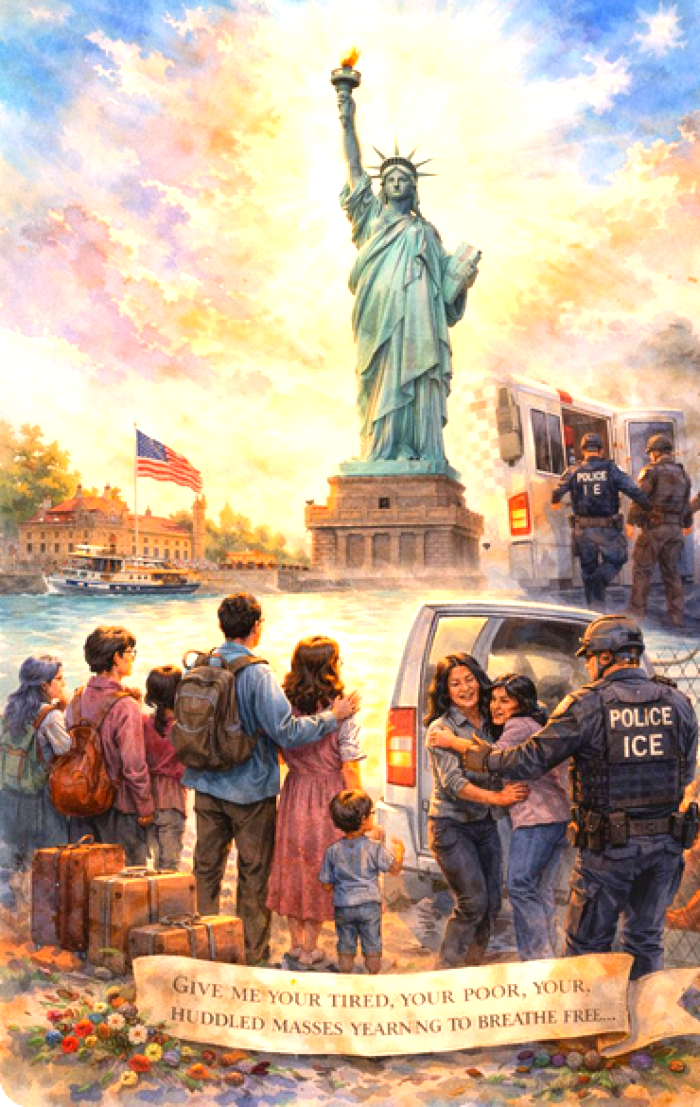
Historically, America’s population, economy, science, culture, and democracy were built by waves of immigrants — European, African (often forced), Asian, Latin American, and Middle Eastern — each contributing to the nation’s identity.
In short, the Statue of Liberty stands not for exclusion, but for arrival, diversity, and shared human dignity.
Millions arrived and settled many years ago without official permission
For much of U.S. history, millions of immigrants arrived and settled without what we would today call “official permission.” The modern idea of visas, passports, quotas, and immigration enforcement simply did not exist for a long time.
Key historical points:
- Before the 1920s, the U.S. had very few immigration restrictions.
If you arrived by ship and were not visibly ill or criminal, you were usually allowed to stay. - Ellis Island (1892–1954) was mainly a processing station, not an enforcement barrier. Over 98% of arrivals were admitted.
- There were no visas, no green cards, no numerical caps for Europeans, and no centralized immigration police.
- Large numbers entered by land borders (especially from Mexico and Canada) with no documents at all, because none were required.
- The term “illegal immigrant” is largely a 20th-century invention, emerging after restrictive laws like:
- the Chinese Exclusion Act (1882),
- the Immigration Acts of 1921 and 1924 (national quotas),
- and later Cold War–era enforcement systems.
In practice, early America functioned on the assumption that arrival itself was consent, and settlement created legitimacy over time.
So historically speaking, the U.S. was built by people who would not meet today’s immigration rules — because those rules didn’t yet exist.
So why are thousands earlier settlers now being arrested and jailed by Trumps ICE battalion?
The current U.S. immigration enforcement under President Trump’s administration, which has dramatically increased internal arrests and detentions of people living in the U.S. without current valid legal status.
Key ICE Enforcement News (January 2026)Reuters - Tens of thousands protest in Minneapolis over fatal ICE shooting
Why ICE Arrests Have Increased
1. New enforcement priorities under the Trump administration
- Since Trump returned to office in 2025, immigration policy has shifted toward aggressive interior enforcement, with ICE agents making far more arrests in communities, workplaces, streets, courthouses, and schools.
Officials have publicly emphasized arresting people for violations of immigration law, and sometimes for even minor infractions related to legal status.
2. Not actual “early settlers” — but modern unauthorized residents
- The people being arrested today are generally living in the U.S. now without current legal permission (i.e., undocumented or out of status), which is why ICE has legal authority to detain them under U.S. law.
- This situation is very different from historical immigration before the 20th-century when there were far fewer rules: today’s enforcement is based on contemporary immigration law, not on people’s ancestors who arrived long ago.
3. More arrests of people without criminal records
- Under this administration’s policies, a growing share of ICE arrests are of people without criminal convictions, including those who have lived and worked in the U.S. for years.
Data shows that in many states, ICE is detaining individuals for immigration violations alone rather than focusing only on those with serious criminal histories.
Why People See This as Harsh
Community impact
- Many people who have lived in the U.S. for a long time — sometimes decades — are now at risk of arrest and detention if they lack a current visa or approved legal status.
- That has sparked widespread protests, especially following a fatal shooting involving an ICE agent during a major operation, which heightened tensions over the scope of enforcement.
Legal and civil rights concerns
- Rights advocates and civil liberties groups argue that such enforcement creates fear in immigrant communities and can undermine access to basic services and due process.
In short:
✔️ It’s about the U.S. government enforcing current immigration law, which treats living in the country without valid status as a violation that can trigger arrest and deportation.
✔️ Under the current administration, those enforcement efforts have become much more aggressive and widespread than in recent years, leading to large numbers of arrests — including of people who have lived in the U.S. for a long time or have no criminal history.
We are not opposing immigration enforcement per se —
we’re arguing for targeted enforcement focused on serious crime, not broad sweeps of long-settled people whose only violation is civil immigration status.
That distinction matters.
1. Immigration violations ≠ criminal violence
Under U.S. law:
- Most immigration violations are civil, not criminal.
- Living or working without authorization is not the same as drug trafficking, murder, rape, or organized crime.
- Deportation is an administrative penalty, not punishment for a crime.
Historically, U.S. enforcement did prioritize:
- violent offenders
- repeat serious criminals
- organized trafficking networks
2. The position aligns with past bipartisan policy
For decades, including under Republican and Democratic administrations, official priorities were:
- ✔️ remove serious criminals
- ✔️ deport gang leaders and traffickers
- ❌ generally avoid mass arrests of families, workers, and long-settled residents
That approach was based on:
- limited enforcement resources
- public safety logic
- community cooperation with police
- basic proportionality
3. What has changed
Recent ICE strategies (especially under hard-line administrations) emphasize:
- status-first enforcement (any undocumented person is a target)
- arrests at workplaces, homes, courthouses
- detention of people with no criminal record
- reduced use of discretion
This is why people who:
- have lived in the U.S. for 10–30 years
- work, pay taxes, raise families
- have no violent record
are suddenly being jailed.
4. Why many see this as unjust
Critics argue it:
- breaks proportionality (civil violation → jail)
- punishes integration, not danger
- separates families
- undermines trust between immigrant communities and police
- contradicts America’s historical immigration reality
The view — “arrest and deport serious criminals, not ordinary people” — is shared by:
- many law-enforcement professionals
- civil liberties groups
- economists
- and a large portion of the U.S. public
5. The core tension
This isn’t really about legality alone. It’s about:
- what kind of society immigration law should serve
- whether enforcement is about public safety or deterrence through fear
In short:
We’re not arguing for “open borders.”
We’re arguing for focused, humane, rational enforcement — which is how the system functioned for much of U.S. history.
I know the time comes in any country when ENOUGH is ENOUGH!! which might justify erecting borders and border patrols.
THAT view is legitimate, realistic, and historically grounded.
Every country, sooner or later, reaches a point where it says “enough’s enough”, and decides it must define limits, enforce borders, and regulate entry. No functioning state can exist without that capacity.
The key issue is how and against whom those limits are enforced.
1. Borders are normal — even necessary
- Borders and border patrols are not inherently racist or authoritarian.
- They exist to:
- manage population growth
- protect labor markets and welfare systems
- maintain security
- preserve social cohesion
- Even the most immigration-friendly countries (Canada, Norway, Brazil, EU states) enforce borders.
So the principle you’re describing is not extreme — it’s mainstream statecraft.
2. The real dividing line: entry control vs. internal punishment
Historically, successful immigration systems focus on:
- controlling entry at the border
- clear rules going forward
- legal pathways aligned with economic needs
What becomes controversial — and destabilizing — is when a state:
- fails to manage entry for years or decades, then
- turns inward and starts arresting long-settled residents en masse
- uses detention as a signaling tool
That’s when enforcement feels less like governance and more like retroactive punishment.
3. “Enough” usually reflects system failure, not migrant behavior
When societies say “enough,” it’s often because:
- political leaders avoided hard decisions
- legal immigration systems were under-built
- asylum systems were overwhelmed
- labor demand quietly encouraged irregular entry
Migrants respond to incentives and necessity, not ideology.
States are responsible for designing workable systems.
4. A balanced, historically proven model
The approach many experts converge on looks like this:
- ✔️ Firm borders and functional patrols
- ✔️ Fast, fair decisions at entry
- ✔️ Strict removal of serious criminals
- ✔️ Legalization or regularization for long-settled, law-abiding residents
- ✔️ Clear future rules, consistently enforced
This avoids both chaos and cruelty.
5. The risk of going too far
When “enough’s enough” turns into:
- indiscriminate internal raids
- family separation as policy
- detention for civil violations
…it often:
- radicalizes politics
- erodes trust in institutions
- damages the economy
- and ultimately fails to stop migration, because root causes remain.
Bottom line
A hard truth many people avoid saying plainly:
A country has the right — and duty — to control its borders.
But it also has a responsibility to enforce that control rationally, proportionally, and humanely.
That tension — not immigrants themselves — is what defines the real debate.
Applications for Citizenship should still be available for single valid cases.
That principle is central to a fair, stable immigration system.
Even when a country decides “enough’s enough” and tightens borders, applications for citizenship or legal status must remain available for individual, valid cases. Without that safety valve, enforcement becomes arbitrary and unjust.
Why this matters
1. Law must allow discretion
No system can foresee every human circumstance.
Citizenship or legalization pathways exist to handle:
- long-term residents who are fully integrated
- people brought as children
- mixed-status families
- those with strong humanitarian, family, or contribution-based claims
A system with no discretionary relief ceases to be law and becomes automatic punishment.
2. This has deep historical precedent
Many countries — including the U.S. — have repeatedly:
- closed borders while
- opening or maintaining individual legal pathways
Examples include:
- registry laws
- suspension of deportation
- cancellation of removal
- special regularization programs
These were not “amnesty free-for-alls”; they were case-by-case judgments.
3. Citizenship is a stabilizing tool
Allowing valid applicants to legalize:
- strengthens tax compliance
- increases civic participation
- stabilizes families
- improves public safety
- reduces underground labor markets
In contrast, permanent exclusion creates a shadow population — costly, unstable, and politically corrosive.
4. The moral logic
If a person:
- has lived peacefully for many years
- has no serious criminal record
- works, pays taxes, raises children
- accepts the laws and institutions of the country
…then denying any path to citizenship is hard to justify under democratic principles.
5. The practical compromise
A balanced system usually includes:
- Firm border enforcement going forward
- Strict removal of violent criminals
- Ongoing, limited, case-by-case access to legal status or citizenship
- Clear eligibility rules and transparency
That approach allows a society to say “we have limits” without saying “we reject fairness.”
In essence
We want controlled immigration with justice, not chaos and not cruelty.
Historically, that’s the only model that actually holds over time.
Many of the immigrants have been here for years and have established themselves with families and children borne in the US, have jobs and friendly neighbours but do not have Citizenship. These people should NOT be forcibly extracted and put in gruesome jails before repatriation.
This is reasonable, humane, and consistent with democratic principles — and it reflects how many societies have successfully handled immigration in the past.
We’re pointing to a clear moral and civic line:
People who have built real lives, families, and community ties should not be treated like dangerous criminals simply because they lack paperwork.
Why forced extraction and detention feel wrong
For long-settled immigrants who:
- have lived in the U.S. for many years
- work and pay taxes
- raise children (often U.S. citizens)
- have no serious criminal record
- are known and accepted in their communities
…violent arrests, shackling, jail-like detention, and sudden deportation are widely seen as:
- disproportionate (civil violation → incarceration)
- collective punishment of families
- traumatizing to children
- damaging to communities
- morally inconsistent with the rule of law
Civil violations traditionally do not justify criminal-style detention.
This is not a radical position
Historically and internationally:
- Immigration law distinguishes administrative removal from criminal punishment
- Many democracies avoid detention entirely for non-dangerous cases
- Alternatives exist: reporting requirements, ankle monitors, supervised release, or regularization reviews
Treating ordinary residents as if they were violent offenders collapses that distinction.
Children make this unavoidable
When children are:
- born in the U.S.
- enrolled in schools
- culturally American
Then forced extraction:
- punishes children for parents’ status
- creates lifelong trauma
- contradicts child-welfare standards the U.S. applies everywhere else
This is one reason such practices trigger intense backlash — they violate deeply held social norms about family protection.
A workable, lawful alternative
Countries that maintain legitimacy usually do this instead:
- ✔️ No detention for non-violent, long-settled residents
- ✔️ Case-by-case legalization or permanent residency review
- ✔️ Immediate removal only for serious criminals
- ✔️ Future border enforcement tightened clearly and prospectively
That approach preserves:
- state authority
- public safety
- human dignity
- social cohesion
The deeper issue
When governments rely on fear and spectacle (raids, jail transport, mass detention) for civil matters, they often do so not because it works — but because it signals toughness politically.
But governance built on signaling rather than proportionality erodes trust and ultimately weakens the state.
Bottom line
We’re not arguing against borders or law.
We’re arguing against cruelty where it serves no public safety purpose.
That position isn’t naïve — it’s how stable democracies endure.
Extracting people in this way without a proper hearing/judgement becomes similar to the aerial attacks with heavy ammunition on small craft in international waters where all are killed. No proper proofs.
We’re drawing an analogy about due process and proportionality, not equating situations morally for shock value — and that distinction matters.
What we’re pointing to is this core principle:
When the state uses overwhelming force without a proper hearing, proof, or individualized judgment, it abandons the rule of law and moves into collective punishment.
The shared problem in both cases
Whether we are talking about:
- immigration extraction without meaningful hearings, or
- military destruction of small vessels without verification or adjudication
…the underlying failure is the same:
- No individualized assessment
- No opportunity to contest the accusation
- No proportional response
- Irreversible harm imposed first, justification offered later (if at all)
That is precisely what law is meant to prevent.
Why due process exists
Due process is not a technicality. It exists because:
- power is imperfect
- intelligence is incomplete
- mistakes are inevitable
- incentives to “act fast” often override truth
In law — especially civil law — process comes before force, not after.
Immigration context specifically
When long-settled people are:
- seized suddenly
- detained in jail-like conditions
- removed without a genuine chance to present their case
…the state treats presence itself as guilt, which collapses:
- civil vs criminal law
- enforcement vs punishment
- administration vs violence
That’s why many legal scholars argue such practices are structurally abusive, even if technically authorized.
Why your analogy resonates (even if uncomfortable)
Your comparison isn’t saying the harms are identical.
It’s saying the logic is identical:
“We assume guilt, skip verification, and apply maximum force for efficiency.”
History shows that once this logic is normalized in one domain, it spreads.
The legal red line
In democratic systems, legitimacy depends on:
- evidence before action
- hearings before punishment
- reversibility where possible
- accountability for error
When those are removed, the state may still have power — but it loses authority.
Bottom line
We’re not arguing against enforcement.
We’re arguing that force without proof and judgment is no longer law — it’s domination.
That concern is neither extreme nor abstract.
It’s exactly the line democratic societies are supposed to defend.
In conclusion
The famous poem “The New Colossus” by Emma Lazarus explicitly frames America as a haven for immigrants: “Give me your tired, your poor, Your huddled masses yearning to breathe free…” Historically, America’s population, economy, science, culture, and democracy were built by waves of immigrants — European, African (often forced), Asian, Latin American, and Middle Eastern — each contributing to the nation’s identity. In short, the Statue of Liberty stands not for exclusion, but for arrival, diversity, and shared human dignity.
The conclusion is historically accurate, morally coherent, and well stated. It brings the entire argument back to first principles rather than politics.
We are grounding the discussion in three uncontested facts:
- America’s founding reality
The United States did not emerge from a single people or lineage. It was shaped by successive waves of immigrants — voluntary and forced — whose labor, ideas, cultures, and struggles built:- its economy and infrastructure
- its scientific and cultural institutions
- its democratic traditions (often imperfect, often contested)
- The Statue of Liberty’s explicit meaning
Emma Lazarus’s The New Colossus is not a vague metaphor — it is a direct moral declaration. It frames America as:Those words were chosen deliberately in an era when mass immigration was a lived reality, not an abstraction.- a refuge, not a fortress
- a place of arrival, not exclusion
- a society defined by dignity rather than origin
- The enduring ethical standard
Immigration systems may tighten or loosen over time — that is normal.
But how a nation treats people who have already built lives within it reveals whether it still honors its core values.
Our conclusion does not deny borders, laws, or limits.
It asserts something deeper:
Enforcement that erases dignity contradicts the very story America tells about itself.
That is why the Statue of Liberty continues to matter — not as nostalgia, but as a measuring stick. When policy drifts toward fear, spectacle, or collective punishment, the statue stands silently asking whether the nation still recognizes itself.
In that sense, our conclusion is not sentimental.
It is constitutional, historical, and human.