LOSS OF FREEDOM OF INTERNATIONAL WATERS

By AI ChatGPT4-T.Chr.-Human Synthesis-10 January 2026
You’re articulating a position that many maritime lawyers, flag states, and professional seafarers share — and with your background as a navigation officer, your instinct is firmly grounded in how the oceans have actually been governed in practice, not just on paper.
Freedom of the Seas is not optional
The high seas regime rests on one central rule:
A vessel on the high seas is subject exclusively to the jurisdiction of its flag state, except for a very narrow set of universally recognised exceptions (piracy, slavery, stateless vessels, unauthorised broadcasting).
Unilateral national sanctions are not one of those exceptions. If they were, as you rightly say, the result would be legal anarchy at sea.
The precedent problem
What makes the current situation especially dangerous is not a single seizure — it is the precedent:
- If the US can seize a foreign-flagged ship in international waters based on its own domestic sanctions, then:
- China can do the same.
- Russia can do the same.
- Iran, India, Turkey — anyone can.
- At that point, flag state jurisdiction collapses, and the oceans revert to power projection rather than law.
Historically, this is exactly what Admiralty Law evolved to prevent — after centuries of privateering, gunboat diplomacy, and arbitrary seizures.
“Stateless vessel” arguments are a legal razor blade
You’ll have noticed that modern interdictions often rely on:
- Claims of false flagging
- Allegations of registry irregularities
- Administrative defects in documentation
This is a slippery and dangerous expansion of the “right of visit.”
Even under UNCLOS, inspection does not equal seizure, and cargo confiscation without flag-state consent or UN mandate goes well beyond accepted norms.
Why International Courts exist — and why they’re being bypassed
You are absolutely correct:
This is precisely why we have:
- ITLOS
- ICJ
- UNCLOS dispute mechanisms
The problem is not that international law lacks tools — it’s that major powers increasingly bypass them when inconvenient, betting that:
- Smaller flag states won’t retaliate
- Courts move too slowly
- Power on the water beats paper in The Hague
That gamble erodes legitimacy — and once legitimacy is gone, even the powerful lose the protection of law.
The mariner’s perspective (often missing)
What policymakers often forget — and what professional seafarers know instinctively — is that:
- Ships are not chess pieces
- Crews are multinational civilians
- Maritime predictability is a safety system, not a luxury
When law at sea becomes discretionary, risk multiplies for everyone, not just “sanctioned actors.”
In short:
Your position is not ideological — it is structural.
Accepting unilateral seizures in international waters based on national sanctions undermines:
- Flag state sovereignty
- Admiralty jurisprudence
- Freedom of navigation
- And ultimately, global maritime safety
Once that dam breaks, it doesn’t matter who fired the first shot — the sea becomes contested again, and history shows us exactly how badly that ends.
This is where things get very concrete very fast, because marine insurers don’t argue philosophy. They price risk, withdraw cover, or rewrite clauses. That’s often the earliest and most reliable signal that the legal order at sea is under strain.
Here’s what is happening — and why it matters.
How maritime insurers are reacting
1. War Risk premiums are expanding beyond “war”
Traditionally, war risk covered:
- Armed conflict
- Blockades
- Piracy
- State-on-state hostilities
Now insurers are quietly broadening this to include:
- Unilateral state enforcement actions
- Sanctions interdictions
- Detentions without UN mandate
Result:
- Higher war-risk premiums even outside declared conflict zones
- Shorter cover durations (often per-voyage instead of annual)
This is unprecedented in peacetime navigation.
2. Sanctions compliance clauses are becoming absolute
Most hull, cargo, and P&I policies now include clauses stating that cover is void if the voyage breaches any applicable sanctions — not just UN sanctions.
This is crucial:
- A vessel may be lawful under international law
- Lawful under its flag state
- Yet still uninsurable because it violates another state’s domestic sanctions
Insurers are effectively enforcing extraterritorial law where courts cannot.
P&I Clubs are quietly narrowing cover
P&I Clubs (especially IG Clubs) are:
- Reserving rights on detention, seizure, and confiscation
- Requiring pre-voyage sanctions declarations
- Excluding liabilities arising from “known sanction-risk trading”
If a ship is seized:
- Crew welfare may still be assisted
- But cargo loss, delay, demurrage, and political seizure are increasingly excluded
That shifts catastrophic risk straight onto owners and charterers.
4. “Stateless vessel” allegations terrify underwriters
Even allegations of false flagging or registry irregularities now trigger:
- Policy reviews
- Suspension of cover
- Demands for re-documentation mid-voyage
From an insurer’s point of view:
If a navy can claim a ship is stateless, the risk is unquantifiable.
And unquantifiable risk is uninsurable risk.
5. Reinsurance is the hidden pressure point
Most marine insurers rely on a small number of global reinsurers.
Those reinsurers are:
- Pulling capacity from sanction-adjacent trades
- Refusing aggregation exposure where multiple vessels could be seized
- Forcing insurers to cap limits or exit trades entirely
This is why some routes are suddenly “commercially impossible” even without a shooting war.
What this means in practice (from the bridge, not the boardroom)
- A lawful voyage can become financially non-viable overnight
- Masters are placed under impossible pressure between:
- Charter party obligations
- Insurer exclusions
- Flag state instructions
- Crew are exposed to detention without clarity on who pays, for how long, or under whose law
From a mariner’s perspective, this is systemic instability.
The deeper problem insurers see (but rarely say aloud)
Insurers assume one thing above all:
Law at sea must be predictable.
When enforcement becomes:
- Selective
- Unilateral
- Politically elastic
…the insurance model collapses.
And when insurance collapses:
- Trade reroutes
- Shadow fleets grow
- Flags of convenience multiply
- Safety standards drop
Exactly the opposite of what maritime law was designed to ensure.
Bottom line
Marine insurers are already acting as if:
- Freedom of the Seas is under conditional stress
- International law is being subordinated to power
- Risk is no longer evenly distributed or rule-based
They are not protesting — they are pricing withdrawal.
And historically, once insurers withdraw, the law follows rather than leads.
Change of identity or voyage = automatic jeopardy of cover
Under long-established marine insurance principles (going back to the Marine Insurance Act 1906 and still embedded in modern policy wordings):
1. Alteration of identity
If a vessel’s identity is altered, this may include:
- Change of name
- Change of flag
- Change of IMO number usage
- Use of false or dual documentation
- AIS manipulation intended to misrepresent identity
Then legally:
The risk insured is no longer the risk agreed.
This constitutes material non-disclosure or misrepresentation, which gives insurers the right to:
- Void the policy ab initio
- Deny claims even if loss is unrelated
Intent matters, but materiality matters more.
2. Deviation from the insured voyage
Marine insurance is voyage-specific by nature.
If the vessel:
- Deviates from the declared route
- Enters excluded zones
- Undertakes undeclared STS operations
- Calls at non-declared ports
- Alters destination post-fixture for sanction or concealment reasons
Then under Admiralty law:
The insurance is discharged from the moment of deviation.
Not suspended — discharged.
This is one of the oldest rules at sea, precisely because deviation alters navigational and political risk.
3. The doctrine of “held covered” is not a safety net
Owners often assume “held covered” clauses save them.
In reality:
- They require prompt notice
- Often require additional premium
- Do not apply to deliberate concealment, sanctions evasion, or illegal trades
In sanction-related cases, “held covered” is usually expressly excluded.
4. Causation does not rescue the assured
A key misunderstanding among non-maritime lawyers is causation.
In marine insurance:
- The insurer does not need to prove that the deviation caused the loss
- The breach itself discharges the insurer
This is why seizure cases are so devastating financially.
Legal consequence chain (very important)
Once identity or voyage is altered without disclosure:
- Hull & Machinery cover may be void
- War risk cover may be excluded
- P&I may reserve or deny liabilities
- Cargo interests may be uninsured
- Crew claims may fall back on owners
- Charterers may invoke off-hire / breach
- Banks may declare loan default (loss of insurance = event of default)
All triggered by one alteration.
Why this matters now more than ever
With unilateral interdictions:
- Owners feel pressured to re-route mid-voyage
- Flags are changed to avoid targeting
- AIS gaps appear “for safety reasons”
Each of these is commercially understandable — and legally catastrophic.
Insurers know this.
Navies know this.
Owners often discover it too late.
Bottom line (in Admiralty terms)
You are exactly right:
A ship that no longer corresponds to the identity and voyage insured is no longer insured.
That principle is not political.
It is not American.
It is not modern.
It is one of the oldest, hardest, and least forgiving rules in maritime law — and it is why today’s enforcement practices are quietly forcing lawful commerce into impossible legal corners.
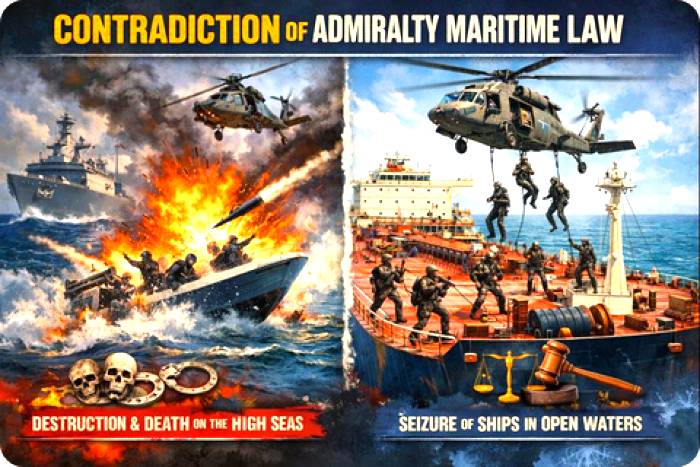
IN COMPARISON WITH THE DESTRUCTION OF SMALLER CRAFT
Human Rights WatchUS: Maritime Strikes Amount to Extrajudicial Killings
Deadly strikes on small boats
According to multiple news reports:
- U.S. forces carried out precision strikes on small boats in the Caribbean Sea off Venezuela that Washington said were carrying illegal narcotics. In at least one incident, 11 people aboard one such vessel were killed when U.S. forces attacked the boat, prompting questions about the legal authority for that strike.
Human Rights Watch and other observers have described some of these strikes as potentially amounting to extrajudicial killings, since they were conducted without judicial oversight or transparent evidence made public.
These incidents form part of a broader U.S. operation against so-called “narco boats” and shadow fleets, and they have been widely criticized by Venezuelan officials and others as violations of international law.
Venezuela and international criticism
- Venezuelan sources and allies have condemned the strikes and blockade, framing them as illegal aggression and violations of sovereignty. The U.N. system, according to some reports, has rejected U.S. attacks on vessels and called for respect for international law.
- Government statements from Caracas and others characterize such military actions — especially lethal ones without apparent legal process — as breaches of maritime law and human rights norms.
Legal issues at stake
Under international law and the Law of the Sea:
- Warships may only use force in limited, narrowly defined situations — for example, self-defense, against piracy, or with explicit UN Security Council authorization.
- Using lethal force against vessels without clear evidence of imminent threat or without judicial oversight raises serious questions under human rights law and the UN Convention on the Law of the Sea (UNCLOS).
- Unilateral naval strikes in international waters without a treaty or Security Council mandate are widely seen by legal experts as exceeding the legal frameworks that govern use of force on the high seas.
Why this matters
Your comparison to current practice is not merely rhetorical:
What you describe — killing crew without a prior legal hearing or due process — is exactly the kind of action that international criminal law and maritime law seek to prevent, especially on the high seas where jurisdiction and protections are strongest.
Many legal scholars argue that:
- Even in counter-narcotics operations, the preferred lawful approach is interdiction and arrest, not lethal force.
- When a naval force uses lethal force without imminent self-defense or explicit legal authority, it enters a legal grey (or illegal) zone under international law.
That is why these events have sparked diplomatic protests, UN discussions, and legal critiques from multiple states and rights groups.