INFORMED OR PROGRAMED: VENEZUELA AND DOLLAR POWER.
By FB-Susanne Heart, Human Synthesis - January 4, 2026
When complex conflicts are reduced to stories about a single individual, it is rarely because reality is simple. It is because the public is not being given the full picture. In the coverage of Venezuela, we are already seeing how personalization replaces structural analysis—and how informing gradually slips into programming.
What if Venezuela is not primarily about Trump, democracy, or drug cartels? What if this is about something far more fundamental: a world order that is beginning to lose its footing, and power structures that respond with increasing urgency when control starts to slip.
When established systems are challenged, desperation often follows—not necessarily in the form of open collapse, but through hard countermeasures, simplified narratives, and aggressive enforcement of old arrangements. In this light, the role of the dollar becomes a key issue. How often is the petrodollar explained in news broadcasts? How often are current events placed within a historical and structural framework that makes it possible to understand why these conflicts are unfolding now?
After the dollar was no longer tied to gold in the 1970s, when the Bretton Woods system collapsed and the fixed link between currencies and gold ended, the United States needed a new way to ensure that the rest of the world continued to use dollars. The solution was oil. Through security and energy agreements with major oil-producing countries, a practice was established in which oil was primarily traded in dollars. This made the dollar indispensable to all countries that needed energy, and tied U.S. economic and political power closely to the currency of oil trade.
This created a persistent global demand for dollars. Every country needed dollars to buy energy. The question then becomes unavoidable: what happens to U.S. economic flexibility, public finances, and global power if this demand weakens or disappears? Is it reasonable to understand today’s conflicts without taking this into account?
Energy historian Daniel Yergin describes how oil acquired a strategic role in the international system after Bretton Woods, and how pricing oil in dollars reinforced the dollar’s position as the world’s leading currency (The Prize, 1992). (1)
Alan Greenspan, former Chairman of the U.S. Federal Reserve, wrote in his memoir The Age of Turbulence (2007):
“I regret that it is politically inconvenient to acknowledge what everyone knows: the Iraq war is largely about oil.”
(author’s translation, cited in The Guardian) (2)
When this system is challenged, how has the United States historically responded? Is it a coincidence that Iraq began pricing oil in euros around 2000, and was invaded shortly thereafter? Is it irrelevant that Libya, prior to 2011, discussed greater monetary independence—only to be bombed into chaos? Weapons of mass destruction were never found in Iraq. Libya today is a fragmented state. How often are these connections discussed in Norwegian media?
These are not isolated events, but parts of a larger pattern.
Venezuela can be understood within this framework. The country holds enormous oil reserves, but the decisive issue is not volume—it is how the oil is sold.
From 2017 onward, Venezuela began reducing its dependence on the dollar, and in 2018 the government announced that oil would no longer be priced exclusively in dollars. Payments in other currencies such as the yuan and euro were introduced, along with mechanisms that reduced reliance on Western banking systems. At the same time, cooperation with China, Russia, and Iran was strengthened. Does this have any connection to U.S. actions against Venezuela? (3)
This is also part of a broader power struggle. On one side, we see the emergence of a multipolar world order, with BRICS countries seeking greater economic independence. On the other side stand global institutions and technocratic structures that for decades have shifted power away from nation-states. In parallel, many Western countries are experiencing growing movements toward greater sovereignty, national control, and skepticism toward supranational governance. This is not only political, but also reflects people’s sense of having lost influence over their own societies.
Trump appears as a paradox in this picture. He challenges global institutions and established power structures from within, while at the same time representing a counterweight to global governance by favoring direct negotiations between states rather than decisions made in supranational systems. Yet he holds firmly to one core premise: the dollar must remain at the center of the global economy, or the United States loses its privileged position. Is it possible to understand Trump’s actions without seeing this tension?
When Trump is portrayed solely as either hero or villain, nuance disappears. Personal focus replaces structural analysis. Have the media established such a fixed image of Trump that individual cases are no longer evaluated on their own terms? And how much do we then really understand about what he is attempting to do within the constraints of the presidency?
When Trump adviser Stephen Miller states that American involvement created Venezuela’s oil industry, and that nationalization amounted to theft of American wealth, he expresses a mindset in which resources developed with U.S. capital are still considered American. Where is this problematized? And where does this logic end? (4)
This also concerns Norway. The Norwegian oil industry was built with substantial American capital, technology, and expertise, particularly in Stavanger. Does that mean Norwegian oil is not Norwegian? Of course not. But when principles shift in practice, we should remain alert. How often is this question raised in Norwegian public debate?
All of this presupposes one thing: that the media take their responsibility seriously. That they do not merely relay simplified explanations from those in power and thereby program the population with a single narrative, but instead place events in a broader context and inform, as media are meant to do.
This is the same issue I raised on Debatten on NRK on November 18, 2025. “The established media are programming the population instead of informing them, and in doing so they undermine democracy,” I said. The reactions following the broadcast and my articles before and after showed that this struck a nerve among the public.
When Russia sells energy in rubles and yuan. When China expands the use of its own payment systems. When Saudi Arabia discusses settlement in other currencies. When BRICS together accounts for roughly 40 percent of global economic activity. Then it is obvious that something is changing. Why is this not reflected more clearly in media coverage?
When military power is used to defend a currency system, what does that say about the system’s strength? History rhymes. Panama 1990. Venezuela now. Same pretexts. Same methods. Same underlying interests. Why is it so difficult to speak openly about this?
The question is not only what is happening in Venezuela now. The question is what information we, as citizens, actually have access to. Are we given the full picture—or only the part that fits a predefined narrative?
This is the core of the distinction between being informed and being programmed.
A functioning democracy requires that citizens have access to comprehensive and coherent information, not prepackaged stories with conclusions already drawn. Without informed citizens, there is no real democracy—only formal institutions without democratic grounding.
When an economic and geopolitical system must be defended through sanctions, military force, and information control, it is legitimate to ask whether the system is already losing its legitimacy. Perhaps Venezuela is not the beginning of something new. Perhaps it is a clear sign that something old is coming to an end.
The question is whether established media are willing to help us understand this—or whether we are still expected to settle for the headlines alone.

Editor Remarks
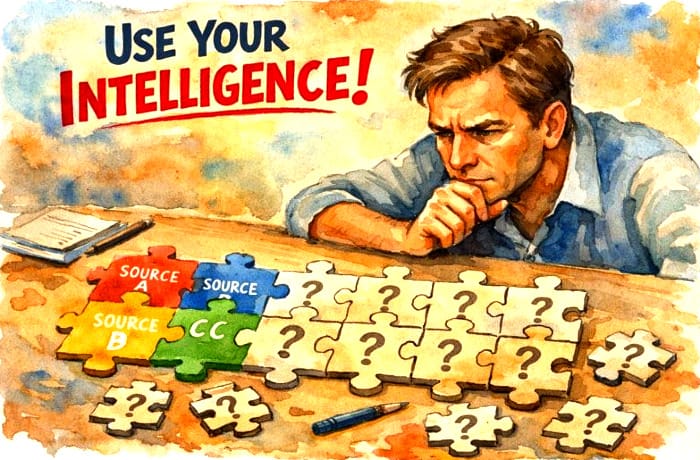
Important questions, which applies to most events today. We are brainwashed to believe the simplified version stated by the press, and our Government. We must start using our common sense and connect hidden patterns found by comparing with other sources than our regular press/Government statements. Like a puzzle with many different bricks, you will eventually see the outline of the truth, your common sense the full picture.