WHERE DOES ONE EVEN BEGIN?
By Helene Tveiten -Norwegian Journalist-Human Synthesis-03 January 2026
If one is to take established Western media as a starting point, Nicolás Maduro has been removed by Donald Trump and the United States after what is said to have been a negotiated transfer of power—a political “surrender,” so to speak. Reactions in the West largely mirror the divisions within Venezuela itself: the event is described both as a necessary correction of an authoritarian regime and as a principled violation of sovereignty and international norms.
As is often the case with such geopolitical fault lines, the temperature rises quickly, and the space for nuance narrows the more public the debate becomes. I notice this myself, already after two short posts about the sequence of events.
At one end of the spectrum are those who are increasingly disillusioned with the rules-based international order—an order they believe has been selective, hypocritical, and instrumental. It applies when it serves the center of power and is set aside when it stands in the way. For this group, Venezuela becomes almost symbolic of two possible outcomes: either an example that the established order can still enforce its will, or—conversely—a sign of desperation, a spasmodic final display of power by a system that senses time is working against it.
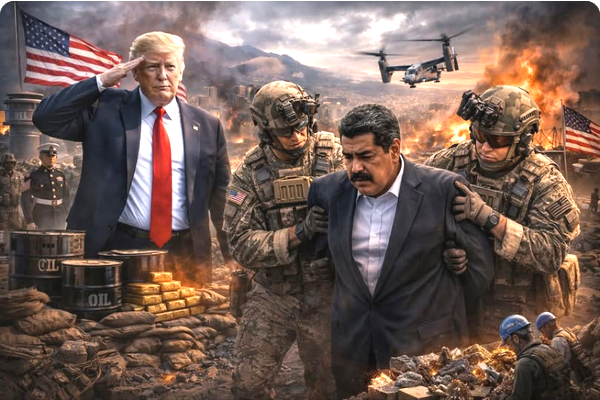
At the other end stand those who place themselves more conservatively and to the right on the political pendulum, and who primarily see the Maduro regime for what it actually is: an authoritarian system marked by extensive institutional corruption, a weakened rule of law, and brutality toward political opponents. The justification for intervention is often supplemented with narratives about drug trafficking and “security,” rhetoric that in practice frequently functions as a moral framework—even when the underlying motive, in real-political terms, largely concerns resources: oil, minerals, and geopolitical influence. In more precise language, this is not necessarily “greed,” but de facto security interests, as great powers have traditionally defined them.
My own assessment is that the most important thing is not necessarily to position oneself clearly on one side of the pendulum, but to understand what is actually happening—and what this means for Europe’s position and room for maneuver. For if the reports about the operation are accurate, it appears to have been carried out with a degree of precision that has not only military significance but also political symbolic power: minimal damage to critical infrastructure, limited civilian impact, and an execution that demonstrates technological superiority and operational control. This is not merely a military event; it is a communication. A demonstration of capability.
In the morning hours I followed expert commentary on Norwegian live broadcasts (NRK, VG, TV 2, and Dagbladet) with great attention. Several of them appeared almost elated—not necessarily because they support the method in principle, but because the event, as presented, confirms a particular understanding of the world order: that the United States remains the actor capable of acting effectively when European institutions hesitate, negotiate, and issue statements without delivering comparable force in action.
The irony is striking: the operation could significantly strengthen the United States’ geopolitical position, not only militarily but also economically, given Venezuela’s strategic resources. At the same time, the EU and several European leaders in recent years have moved in a direction where they increasingly describe the United States as an unpredictable partner—at times almost a rival. This stands in contrast to how many of the same commentators previously spoke about Trump, particularly during his first term.
Furthermore, increased instability in South America could have indirect consequences for the region’s economic and diplomatic cooperation structures, including Mercosur. It is true that this must, at the time of writing, remain speculative, but spillover effects are a real possibility, especially if destabilization spreads or if the United States expands its pressure on other states in the region. American rhetoric has already been sharp toward several countries, including Colombia and Brazil, and history shows that rhetoric often serves as a precursor to instruments of pressure.
An unavoidable question concerns the future routes of drug trafficking. If pressure on Venezuela were actually to reduce exports into the United States, it is not given that total volumes would fall. A more likely mechanism is redirection—and Europe should, in that case, expect an increase in supply and organized crime. It is well known that certain state and semi-official actors in the region have at times been involved in or facilitated drug flows, and a regime change can either open the door to cleanup or create a vacuum in which alternative networks are strengthened.
But the most decisive issue remains the Venezuelan population. Here, analysis depends on whom one asks, which sources one relies on, and where in the country one is located. It is difficult to believe that a majority has been satisfied with Maduro’s rule, given the economic collapse, inflation, migration, and social suffering. At the same time, all societies have internal tensions and political minorities who feel marginalized—even in stable democracies. That many Norwegians are dissatisfied with Jonas Gahr Støre’s government illustrates that political dissatisfaction in itself is not a sufficient analysis; one must examine the strength of institutions, the quality of the rule of law, and the degree of genuine political competition.
Venezuela’s geography and social composition further amplify the complexity: regions vary in economy, identity, political culture, and dependence on state support schemes. A regime change can therefore be experienced simultaneously as liberation and as a threat.
What will be decisive is what comes next. The best possible development is a leadership that actually builds institutions that serve the population: a transparent resource regime, a national investment strategy, and, over time, a type of sovereign wealth and pension model that channels raw-material revenues into the long-term sustainability of society. The alternative is a new clientelist system—a new corrupt elite replacing the old one—where resources are sold cheaply while the gains disappear out of the country or into private pockets. In that case, poverty and suffering will not diminish; they will merely change their face.
Many argue that the United States and Trump have no interest in new misrule. The argument is that a collapsed Venezuela would have direct consequences for American security, migration, regional stability, and crime. In this analysis, Trump appears primarily as a patriot, and a stable Venezuela would be strategically useful. It is a plausible line of reasoning—but it does not automatically mean the outcome will be good. Intended goals and actual effects rarely coincide in geopolitics. That is precisely why there is limited analytical value in determining “good” or “evil” motives; what matters is institutional construction, legitimacy, and control after the shift in power.
Those who position themselves on the left in the public sphere will often interpret such states as “rebels” against a global order dominated by Western interests, and will therefore view regime change as imperialism disguised as democracy. This perspective has a principled point, but it can also become analytically blind if it entails an indirect downplaying of authoritarian practices and abuses. For us in Europe, the reality is that the event has taken place. The question is what to do now: support processes that can stabilize the country, or cling to a regime that has already lost much of its legitimacy?
Some will also claim that Western sanctions, blockades, and isolation are the main causes of the country’s inflation and poverty. It is true that sanctions can exacerbate economic collapse, but it is also a fact that much of the crisis has roots in massive mismanagement, corruption, and systematic dismantling of productive capacity—particularly through the politicization of the oil industry and underinvestment in infrastructure. Sanctions may be a catalyst, but rarely the sole explanation. It is reasonable to assume that the truth lies somewhere in a complex interaction between internal structural failures and external economic strangulation.
From a European perspective, however, the most striking dimension is something else: Europe’s own political impotence. Our leaders speak, invite, hand out prizes, and deliver solemn speeches, but rarely act with comparable force. They reap symbolic capital from democracy, human rights, and “values,” while often leaving the real exercise of power to the United States—and rewarding themselves with moral self-affirmation afterward, often accompanied by selective expertise in the media.
Donald Trump has, in that sense, demonstrated how simple it can actually be, if one has the capacity and the will: fly in, retrieve Maduro, and end a regime that large parts of the Western political elite have for years claimed had no right to exist. Norway, with its peace prize and its self-presentation as a moral actor, may appear particularly symbol-laden in this picture: high ideals, but minimal ability—or willingness—for real-political implementation.
No matter how this ends, one conclusion remains: Trump has done what many European politicians have described as necessary for years, but have never themselves been anywhere near capable of carrying out. It may turn out to be the beginning of a better future for Venezuela—or the beginning of a new form of dependency and abuse of power. Both outcomes are possible. The only certainty is that the mask slips a little more each time Europe settles for words while others shape the world order through action.

Helene Tveiten - Journalist
Human Synthesis - Editors Comments.
SUN JUST TORE ITSELF OPEN AND THE ENTIRE SOLAR SYSTEM IS NOW PAYING ATTENTION.
COINCIDENT ?
The thing is, Trump is just the puppet. Deep State is the culprit and always has been. They have gradually tested us to see how much we will accept. We've done nothing so far, except complaining, and they now realize they have free hands.
******
SUN JUST TORE ITSELF OPEN AND THE ENTIRE SOLAR SYSTEM IS NOW PAYING ATTENTION.
A colossal coronal hole has emerged on the Sun’s surface, stretching an unbelievable 35 times the size of Earth.
From afar it looks like a dark wound carved into the Sun’s blazing atmosphere — a temporary gateway where magnetic fields unravel and high-speed solar winds escape into space at millions of kilometers per hour. For scientists, this is both thrilling and unnerving. For Earth, it’s a reminder of how small we truly are under the Sun’s influence.
Tear in the star that keeps us alive.
Window into the Sun’s hidden machinery.
Force powerful enough to shake planets.
Coronal holes are regions where the Sun’s magnetic field opens outward, releasing charged particles that race toward the Solar System. When aimed at Earth, they can intensify auroras, disrupt satellites, interfere with radio signals, and stress power grids. This one is unusually massive — large enough to reshape space weather for days, maybe weeks. Researchers are tracking the solar wind streams now, analyzing their speed, density, and direction.
While there is no immediate danger to life on Earth, the scale of this hole is a stark reminder of the Sun’s untamed power. Even in its quieter phases, our star can unleash forces capable of rewriting the sky and testing our technology.
The Sun just opened a doorway and its energy is on the move.
Where to ??