THE STORY OF ÖTZI - YR. 5000
By A ChatGPT4-Source FB-T.Chr.-Human Synthesis 01 January 2026
A human body emerged from the ice, and at first, authorities assumed it belonged to a modern mountaineer who had recently died in the mountains. That assumption would soon collapse under the weight of one astonishing discovery after another.In September 1991, two hikers in the Ötztal Alps, near the border of Austria and Italy, noticed what appeared to be a man frozen halfway out of a melting glacier.
His skin was darkened by exposure, his clothing was torn and weathered, and one arm stretched forward as if he had been crawling when he died. The scene looked tragic but familiar, as alpine accidents were not uncommon.However, when officials arrived and examined the objects near the body, nothing matched a modern explanation. The tools were not made of steel, the clothing was not woven from contemporary materials, and the axe found beside him was crafted from nearly pure copper. This alone suggested the man belonged to a time far earlier than expected.
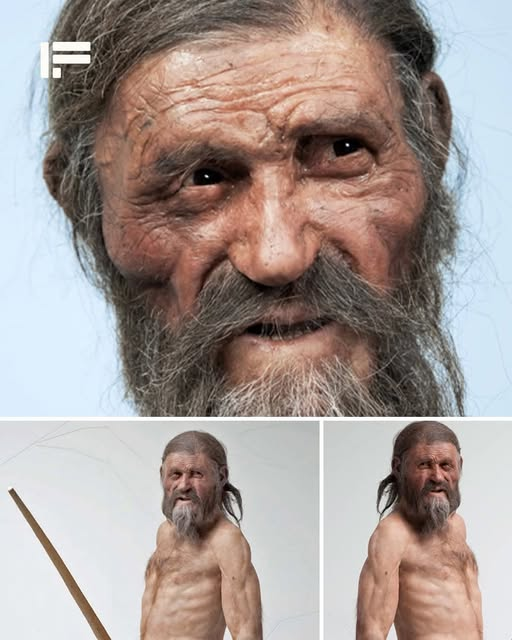
Carbon dating confirmed the unimaginable.
The man had died around 3300 BCE, more than 5,300 years ago, making him older than the Egyptian pyramids and far older than any known written history in Europe. He was eventually named Ötzi, after the Ötztal mountains where he was found.What made Ötzi extraordinary was not only his age, but his preservation. The ice had sealed his body almost immediately after death, preserving his skin, organs, stomach contents, and even microscopic pollen inside his digestive system. Scientists were able to determine his final meals, track his movements weeks before his death, and diagnose chronic conditions including arthritis, parasites, and long-term physical stress.
Then came the discovery that transformed the story entirely.
An arrowhead was found lodged deep in his shoulder. Further scans revealed that the arrow had severed a major artery, causing rapid internal bleeding. A head injury suggested he collapsed suddenly, either from the wound or a secondary blow. Ötzi had not frozen to death. He had been killed.His body was never buried. Snow quickly covered him, and ice locked the scene in place for more than five millennia.
The identity of his killer remains unknown. Ötzi also carried clues etched into his skin. More than sixty tattoos made up of simple lines and crosses were found across his body. These markings were not decorative, and many aligned closely with acupuncture points, suggesting therapeutic treatment for pain thousands of years before traditional Chinese medical texts described similar practices.
His copper axe also changed historical understanding.
Copper tools were once believed to be rare or ceremonial during this era, but Ötzi’s axe showed heavy use. This indicated that advanced metallurgy, social status, and violent conflict were already shaping human societies much earlier than previously believed. Ötzi was not a primitive caveman. He was skilled, mobile, technologically equipped, and living in a dangerous world.
Today, Ötzi is kept in a temperature-controlled chamber, preserved exactly as he was found. Scientists continue to study him using new technologies, uncovering additional injuries and insights with each passing decade. Yet one question remains unanswered.Who killed him?One man died in the Alps before history had names. Ice erased his presence, and science restored it.
Ötzi became famous not because he lived, but because death preserved him long enough to tell us who we once were. His story reminds us that violence, medicine, and technology have always been part of the human story, even at its very beginning.