EXTENSIVE GOVERNMENT FUNDED FRAUD.
By AI ChatGPT-T.Chr.-Human Synthesis- 31 Dec. 2035. Source FB xxx
When I reflect on the extensive fraud and corruption networks that have been linked to Somali environments in several Western countries, it is difficult not to react with disbelief. The scale is not merely troubling—it appears, in principle, unprecedented.
The examples range from childcare and daycare subsidy schemes in the United States (particularly Minnesota), where billions of dollars were paid out without a single child ever attending, to similar patterns in Denmark, Sweden, and Norway, documented as early as 2012 and likely even earlier. In Sweden, the scope has on several occasions matched the American level. The mechanisms vary in form but not in function: fictitious football tournaments, “sports clubs” that exist only on paper, and ostensibly legitimate organizations that turn out to be little more than automated payout machines.
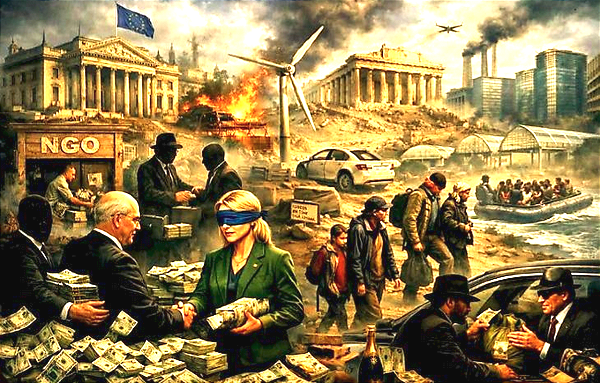
The most serious aspect, however, is not merely the remarkable degree of trust and institutional naïveté displayed by public authorities, but the fact that certain actors—over time and through access to power—have also found their way into politics and the public administrative apparatus of Western democracies. From these positions, they have been able to influence the allocation of public funds toward projects that are either dubious imn nature or function directly as financial transfer channels to their own networks. While it is true that Somalis in many countries appear overrepresented in such cases, the phenomenon is not confined to any single group.
This is a systemic problem that cuts across nationalities and arises largely at the intersection of differing cultural norms and value systems with Western institutional structures that are, in many cases, designed for high trust and low levels of control. It is nonetheless crucial to understand that this type of fraud and corruption is not an isolated, migration-related phenomenon. Structural similarities can be found in entirely different sectors, including those where the actors have no immigrant background. A relevant example is the insect industry, which emerged as a “green” trend around 2015 and has largely been sustained by public subsidies rather than genuine market demand.
Ynsect, one of Europe’s most high-profile companies in this field, has recently declared insolvency after raising approximately NOK 2.5 billion in capital. In Norway, between three and five insect companies have survived on taxpayer-funded support schemes and hundreds of millions of kroner since 2016, with little meaningful willingness from private investors to back the projects. When the public sector systematically becomes the primary financier of business models that the market explicitly rejects, a pattern emerges that resembles a subsidized illusion economy more than genuine industrial development.
This has striking parallels with several of the most controversial projects of the past decade: battery factories that promised revolution, wind power developments often marketed as future industries without sufficient sustainable profitability, and a range of other prestige projects in which the economic “substance” proved far thinner than the political rhetoric. In these cases, the mechanism is the same: a shell is constructed—an organization, a factory, a plan—and filled with public money, while realism, oversight, and accountability remain secondary.

It is legitimate—and necessary—to direct sharp criticism at actors who deliberately exploit the welfare state and public support schemes through systematic fraud. If individuals participate in organized deception against the collective, there must be real consequences, including deportation where the legal framework permits it. At the same time, intellectual honesty requires acknowledging that this is not primarily a “Somali” problem, but one that exposes a far broader and more fundamental institutional weakness: a Western model that has made itself dependent on trust-based governance while simultaneously building an ecosystem of support schemes characterized by unclear responsibility, weak oversight, and low sanctioning capacity.
It would be reassuring to believe that revelations and scandals represent the first dominoes in a systemic collapse that forces reform and more equitable economic governance. But current developments offer little reason for optimism. Not long ago, it was reported that the EU had “lost” around €400 billion without clear traceability, and around the same time it was revealed that the Italian mafia had established organizations in the name of the green transition—and even set forests on fire—to trigger financial support schemes.
When such events can occur within systems as large and resource-rich as the EU, it speaks to an administrative culture in which control is often an afterthought rather than a foundation.Somalis thus appear more as a symptom than as the cause. The problem runs deeper: in a Europe and a Western political system that have gradually eroded their capacity to manage public funds with restraint, and their willingness to crack down decisively on abuse—regardless of who is responsible. It is naïve to claim that such conditions go unnoticed. They are visible in practice: employees of institutions driving luxury cars they clearly cannot finance through legitimate income, and business owners who can point to financial structures and accounts in tax havens.
The suspicion has always been there; the discussion has always existed. Yet the political consequences have nonetheless been marginal. The case involving Kebreab illustrates precisely this dynamic: tens of millions were channeled into cultural and theatrical projects, regulations were bent, and allocations flowed to friends and associates. The phenomenon is not new—it has merely been normalized through repetition, lack of consequences, and a public system that in practice often rewards networking and symbolic politics more than results and accountability.
The decisive question, therefore, is not whether specific groups or individuals defraud the system—there will always be actors who attempt to do so—but why the system is constructed in such a way that it can be exploited so extensively, repeatedly, without structural reform.
When public funds become a permanent fuel source for both migration-related fraud and elite-anchored prestige projects, the problem is no longer merely criminality or “cultural collision,” but institutional decadence: a state and a union that have lost the ability to distinguish between nation-building and money flows, between legitimate needs and political ornamentation, between responsibility and rhetoric.
Until this fundamental weakness is addressed, new networks—regardless of ethnicity, industry, or ideological label—will inevitably continue to fill the void.