US Relied on Illegal Sanctions to Seize Venezuelan Oil Tanker

By ScheerPost-Marjorie Cohn - Truthout - Dec. 17, 2025
US armed forces’ seizure of the oil tanker constituted an unlawful use of force in violation of the UN Charter.
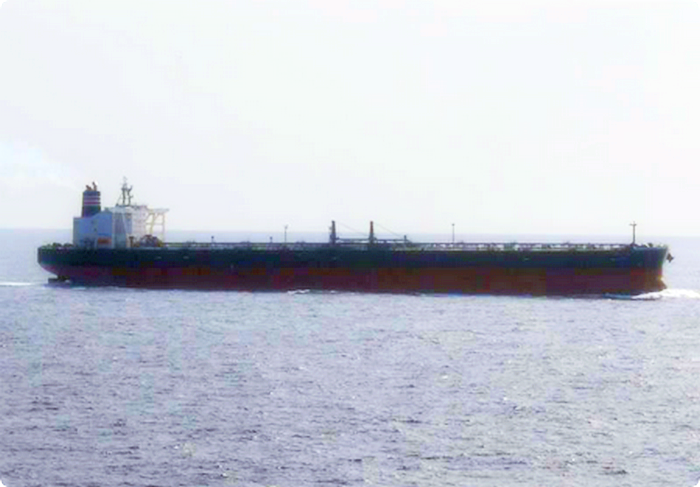
“We have just seized a tanker on the coast of Venezuela — a large tanker, very large, the largest one ever seized actually,” Donald Trump told reporters on December 10, describing the escalation of his apparently impending illegal war and regime change in Venezuela. Attorney General Pam Bondi ceremoniously released a video clip of the U.S. Marines and National Guard rappelling down from two helicopters onto the tanker.
In seizing the “Skipper,” the Trump administration relied on sanctions the U.S. had imposed on the Venezuelan oil tanker. Bondi said a seizure warrant was executed by the U.S. Coast Guard, FBI, Pentagon, and Homeland Security Investigations. “For multiple years, the oil tanker has been sanctioned by the United States due to its involvement in an illicit oil shipping network supporting foreign terrorist organizations,” she stated.
But those sanctions are illegal and cannot provide a lawful basis for the U.S. to seize this vessel.
Only the Security Council Is Authorized to Impose Sanctions
Although claims in the corporate media that Venezuelan oil is subject to “international sanctions” are ubiquitous, nothing could be further from the truth.
When a country takes it upon itself to impose sanctions without Security Council approval, they are called unilateral coercive measures, which violate the UN Charter.
The U.S. government imposed unilateral coercive measures on the oil tanker in 2022 for its alleged ties to Iran. But the UN Charter empowers only the Security Council to impose and enforce sanctions. Article 41 specifies:
The Security Council may decide what measures not involving the use of armed force are to be employed to give effect to its decisions, and it may call upon the Members of the United Nations to apply such measures. These may include complete or partial interruption of economic relations and of rail, sea, air, postal, telegraphic, radio, and other means of communication, and the severance of diplomatic relations.
“Under international law, we cannot lawfully enforce U.S. domestic law in a foreign state’s territorial sea (12 nautical miles) or contiguous zone (next 12 miles out, to total 24) without the coastal state’s consent,” Jordan Paust, professor emeritus at University of Houston Law Center and former captain in the U.S. Army JAG Corps, told Truthout.
Francisco Rodriguez, senior research fellow at the Center for Economic and Policy Research, concurs. “The US has no jurisdiction to enforce unilateral sanctions on non-US persons outside its territory,” he posted on X. “The seizure of ships in international waters to extraterritorially enforce US sanctions is a dangerous precedent and a violation of international law.”
“Nor can we lawfully do so on a foreign flag vessel there or on the high seas without the flag state’s consent — all absent any international legal justification under the law of war during an actual ‘armed conflict’ or under Article 51 of the UN Charter in case of an actual ‘armed attack,’” Paust added.
Although there are allegations that the Skipper was operating under a false flag, Trump made clear in his December 10 statement that it was in Venezuela’s territorial sea or contiguous zone, not on “the high seas.” Moreover, a senior military official told CBS News that the tanker had just left a port in Venezuela when it was seized.
The Seizure Was an Illegal Act of Aggression
At first blush, it appears that the U.S. military committed piracy when it seized the Skipper. But piracy is defined by Article 101 of the UN Convention on the Law of the Sea as acts committed for private purposes by a private aircraft or ship. State-sponsored or military actions can constitute acts of war or violations of sovereignty, but not piracy.
The UN Charter prohibits the threat or use of force except in self-defense after an armed attack under Article 51 or when approved by the Security Council, neither of which was present before the seizure of the Skipper. Nor was the U.S. engaged in armed conflict with Venezuela.
General Assembly Resolution 3314 sets forth the definition of “aggression,” which has been adopted by the Rome Statute for the International Criminal Court: “Aggression is the use of armed force by a State against the sovereignty, territorial integrity or political independence of another State, or in any other manner inconsistent with the Charter of the United Nations.”
The seizure of the oil tanker by the U.S. armed forces constituted an unlawful use of force in violation of the UN Charter. It was therefore an act of aggression.
This aggression comes on the heels of the Trump administration’s extrajudicial executions (murders) of some 87 alleged drug traffickers on more than 20 small boats in the Caribbean and Eastern Pacific. In all likelihood, the administration doesn’t even know the identity of the victims, nor has it provided any evidence that they were trafficking in narcotics. Even if it had, due process requires arrest, not murder.
The U.S. has seized “sanctioned” oil in the past, during the first Trump administration and the Biden administration as well. But, according to The New York Times, it is not a common practice and “rarely becomes a public spectacle.”
Meanwhile, the administration is engaging in the largest military buildup of U.S. firepower in the Caribbean in decades, including the deployment of the USS Gerald R. Ford, the biggest aircraft carrier in the world. Trump declared a no-fly-zone over Venezuela. And the administration recently added significant combat equipment to that already present in the region.
On December 11, the U.S. Treasury Department imposed additional sanctions on the government of Venezuelan President Nicolás Maduro, targeting his relatives and six shipping companies operating in Venezuela’s oil sector.
If U.S. Regime Change Succeeds in Venezuela, Cuba May Be Next
Trump has clearly stated his intention to attack Venezuela, and his administration has signaled that it aims to change Venezuela’s regime, with opposition leader María Corina Machado waiting in the wings. Hours after it seized the Skipper, the U.S. helped Machado leave Venezuela and travel to Norway to receive the Nobel “Peace” Prize.
Maduro called the seizure of the tanker what it really is: “It has always been about our natural resources, our oil, our energy, the resources that belong exclusively to the Venezuelan people.” Venezuela has the largest proven oil reserves in the world.
This seizure could be the first act in the U.S. imposition of an oil blockade on Venezuela. Such a blockade “would shut down the entire economy,” former Biden administration Latin America adviser Juan González told the Guardian.
“Because Venezuela is so dependent on oil, they could not resist that very long,” retired U.S. Marine Corps Colonel and senior adviser at think tank Center for Strategic and International Studies Mark Cancian, told the BBC. It would be “an act of war.”
The oil tanker had offloaded a small amount of its oil to a smaller ship headed for Cuba and then proceeded east toward Asia before the tanker was seized by the U.S. That seizure “is part of the US escalation aimed at hampering Venezuela’s legitimate right to freely use and trade its natural resources with other nations, including the supplies of hydrocarbons to Cuba,” the Cuban Foreign Ministry said in a statement.
Secretary of State Marco Rubio, architect of Trump’s Venezuela regime change strategy, has long had the Cuban government in his sights. “Their theory of change involves cutting off all support to Cuba,” González told The New York Times. “Under this approach, once Venezuela goes, Cuba will follow.”
For decades, Cuba has suffered under unilateral coercive measures in the form of an economic blockade, which was also imposed by the U.S. in violation of the UN Charter.
Forcible regime change is illegal. The UN Charter prohibits the use of force against the territorial integrity or political independence of another state. Likewise, the Charter of the Organization of American States forbids any state from intervening in the internal or external affairs of another state. And the International Covenant on Civil and Political Rights guarantees the right to self-determination.
Trump’s new National Security Strategy contains the “Trump Corollary” to the Monroe Doctrine, signaling a return to U.S. military interventions in Latin America. The strategy states:
We want to ensure that the Western Hemisphere remains reasonably stable and well-governed enough to prevent and discourage mass migration to the United States; we want a Hemisphere whose governments cooperate with us against narco-terrorists, cartels, and other transnational criminal organizations; we want a Hemisphere that remains free of hostile foreign incursion or ownership of key assets, and that supports critical supply chains; and we want to ensure our continued access to key strategic locations.
Washington’s brutal anti-immigrant policies and false accusations that Venezuela is sending drugs to harm the U.S. are consistent with this strategy. And implicit in the strategy is the key goal of U.S. access to Venezuela’s rich oil deposits.
In one of the scariest moments in modern history, we're doing our best at ScheerPost to pierce the fog of lies that conceal it but we need some help to pay our writers and staff. Please consider a tax-deductible donation.

Marjorie Cohn
Marjorie Cohn is professor emerita at Thomas Jefferson School of Law, dean of the People’s Academy of International Law, and past president of the National Lawyers Guild. She sits on the national advisory boards of Veterans For Peace and Assange Defense, and is a member of the bureau of the International Association of Democratic Lawyers and the U.S. representative to the continental advisory council of the Association of American Jurists. Her books include Drones and Targeted Killing: Legal, Moral and Geopolitical Issues. Author SIte
Editor Notes
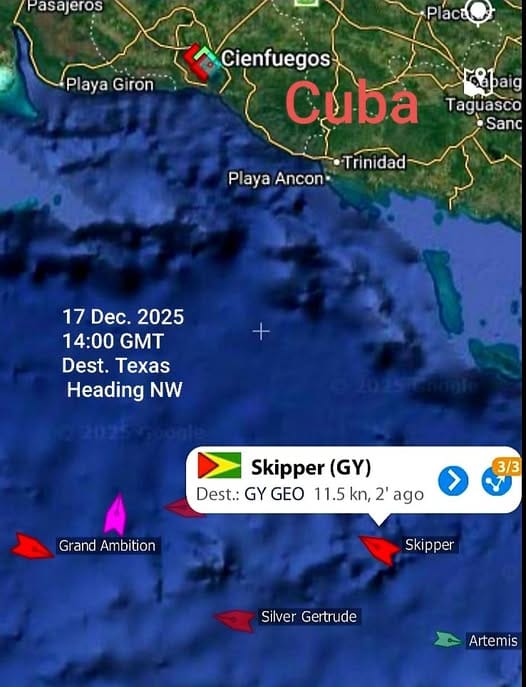
The MT Skipper is today very near to anchor in a bay in Haiti to unload her stolen crude-oil cargo. They have switched off their AIS transmitter. Tricking us again. Now 17 Dec at 14.00 GMT on course for Texas again.