THE STATUE OF LIBERTY
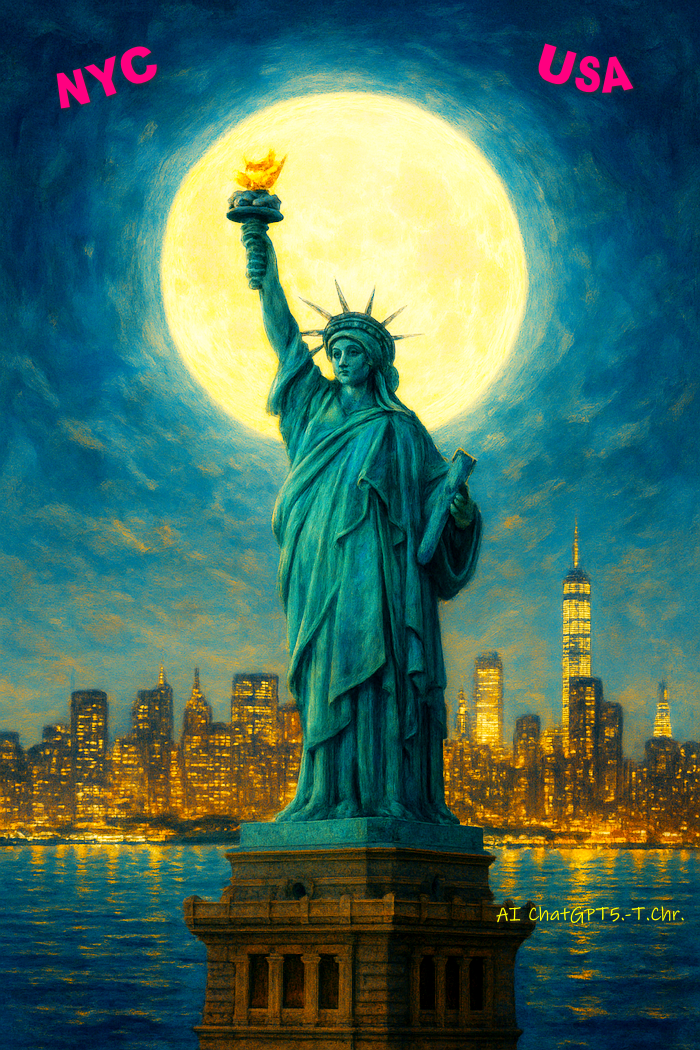
By AI ChatGPT5.-T.Chr.-Human Synthesis-09 December 2025
For a few quiet minutes, New York Harbor seemed to fall under a gentle spell. The full Moon climbed past the edge of the horizon and rose above Lady Liberty’s outstretched torch, glowing with the calm confidence of winter light.
Then, as if responding to some silent celestial cue, a pale 22-degree halo formed around it—a perfect ring, fragile yet unmistakably bright. It hovered there like a crown made not by human hands, but by the careful geometry of ice crystals drifting far above the Earth.
The ferries continued their crossings, their engines humming against the stillness, but their motion suddenly felt softer, slower, like moving through a moment too delicate to disturb. Lights shimmered on the water, stretching toward Liberty Island in wavering golden lines. Even the wind, carrying its usual cocktail of salt and city grit, seemed briefly gentler.
For nearly 140 years, the Statue of Liberty has been the harbor’s unwavering sentinel. She has watched steamships give way to ocean liners, and ocean liners give way to airplanes streaming overhead. She has witnessed the birth of skyscrapers, the shifting of borders, the changing tides of every decade. Yet it is the early chapters of her story—the years when she stood as the first glimpse of America for millions—that still echo most deeply.
From the late 1800s through the early 20th century, she was the first familiar figure on a foreign horizon for families who had spent weeks at sea. They came from Italy, Ireland, Norway, Sweden, Germany, Poland, Greece, China, the Caribbean islands, Latin America, and distant corners of Russia and Eastern Europe. Many arrived exhausted, seasick, or afraid, clutching a single suitcase or the hand of a loved one. Some had left behind famine or war; others had left behind nothing at all except the hope of a second chance.
When they sailed into this harbor and saw her torch held high, something inside them settled. Her welcome was wordless, but it was enough. At Ellis Island, they stood in endless lines, holding documents creased from nervous hands. But through those long hours, they knew she was there—watching, steady, unchanging.
Last night, as the lunar halo circled the Moon like a spectral crown, it felt as if the sky itself were acknowledging the untold stories of those arrivals. The ring of refracted moonlight looked almost ceremonial, a wreath suspended above the monument that has silently greeted nations of newcomers for generations. It was a tribute not only to the statue, but to the millions who stepped ashore and helped build the country brick by brick, field by field, railroad tie by railroad tie.
Their labor carved tunnels beneath Manhattan, laid tracks across deserts, harvested wheat across the plains, stitched garments in crowded factories, and raised neighborhoods block by block. They brought languages, customs, and traditions that blended—sometimes clashed, sometimes intertwined—into the layered tapestry that became America. Their children and grandchildren would one day shape the arts, sciences, politics, and industries of the nation. And all of it began with a ship, a harbor, a torch, and a single moment of hope.
Along the waterfront last night, people sensed that history, even if they couldn’t quite put it into words. Tourists fell silent. Commuters paused with their hands still in their coat pockets. A few children pointed upward, fascinated by the glowing ring in the sky. Cameras clicked, but the moment felt like something meant to be experienced first, captured second.
Cirrus clouds, thin as a painter’s wash of frost, drifted across the heavens. They held the halo in place just long enough for everyone who looked up to feel that they were witnessing something gently extraordinary—nature offering a rare nod to the past. The air tasted of winter; the faint hum of the city blended with the soft lapping of the tide. It was as if time had briefly stretched, and the past and present were breathing in unison.
In that alignment of moonlight, ice crystals, memory, and monumental stone, New York felt momentarily humbled. The city that roars with ambition every day seemed to bow its head. And Lady Liberty, steadfast since 1886, looked as though she were being honored for everything she has represented: courage, arrival, struggle, hope, and the millions who came seeking a new beginning.
It felt, just for that night, as if the heavens themselves whispered in her direction: Thank you for welcoming the ones who built this nation. Thank you for standing watch. And for a few luminous minutes, the winter sky placed a shimmering wreath above her—its quiet gesture of gratitude drifting high above the harbor, before fading softly back into the night.