RETURN TO MAPLE RIDGE
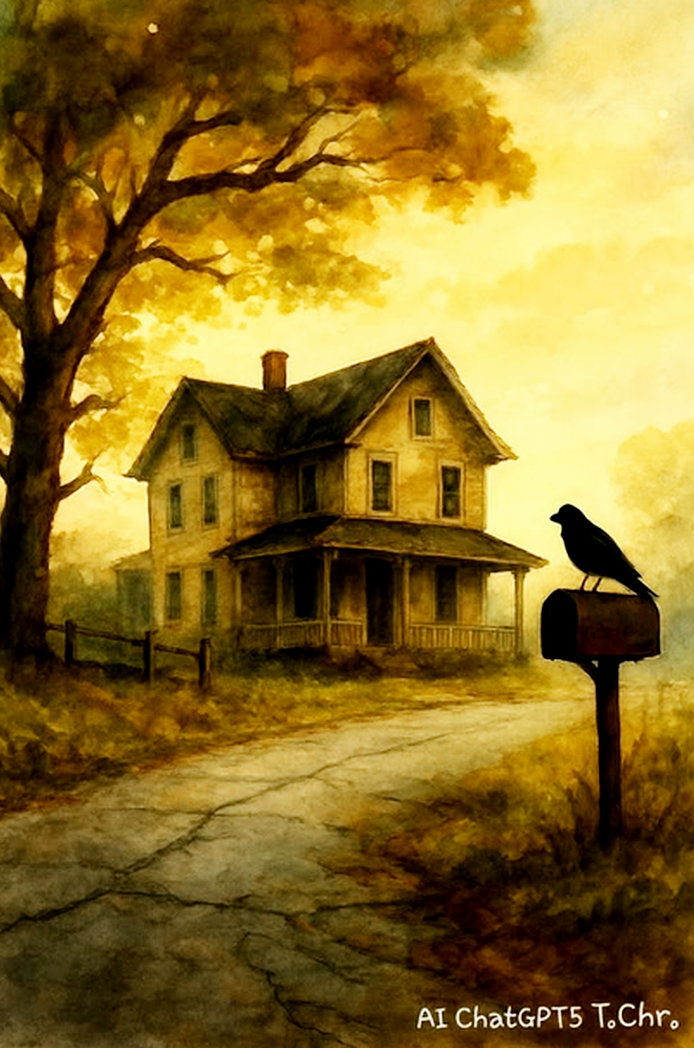
By AI ChatGPT5-.T.Chr.- Human Synthesis-09 December 2025
Jonathan Hale returned to Maple Ridge after twenty-eight years of absence. The drive into the quiet town felt as though time itself had been reluctant to move forward. The same leaning oaks lined the road, their branches forming a canopy of shadows that shifted with the wind. The same wooden fences sagged in the same tired places.
The same stretch of cracked pavement led downhill toward the neighborhood he once roamed as a boy.At the end of the block, the old Hale family home stood waiting. Jonathan parked his car in front of the house that had shaped his childhood and stolen his adolescence. White paint peeled from the sidings in thin flakes, and the porch seemed to bow under the weight of years of neglect. A rusted wind chime hung crookedly beside the door, producing faint metallic sounds too soft to be produced by the wind.
A crow perched on the mailbox, watching Jonathan with an unblinking stare, as though expecting him.When Jonathan’s mother died a month earlier, the house became his. The lawyer’s letter announcing the inheritance came with a single metal key taped to an envelope and a brief handwritten note from his mother dated four days before she passed: This belongs to you now. There had been no mention of memories. No mention of the past. No mention of Emily.
Jonathan stepped out of the car and approached the door.The gravel crunched beneath his shoes, echoing like brittle bones breaking. A coldness rose from within the house as though welcoming him with a breath of stale air. He inserted the key into the lock, fearing that it might refuse him, but the mechanism yielded with a reluctant click. He stepped inside.
THE GHOSTS THAT LINGERED
The interior of the house felt suspended in time. Dust clung to every surface, but the placement of objects suggested nothing had been touched or moved since the day Jonathan walked out as a teenager. A coat hung from its old hook by the door. A pair of boots sat in their worn place near the mat. A framed photograph of the Hale family remained tilted at its chronic angle on the wall, Jonathan adjusted the frame. The image captured an innocent moment: his father’s proud smile, his mother’s patient posture, his own carefree grin, and little Emily’s bright face glowing with the excitement of childhood.
Seeing the picture awakened a familiar ache. Emily Hale had vanished when she was eleven years old. One October evening, she disappeared inside this very house. The police had searched for weeks.The neighbors whispered theories. The family fractured in silence. No evidence was ever found. The living room felt exactly as Jonathan remembered. The sofa sagged at the same cushion where his father used to sit after work. The fireplace bore the same darkened edges from decades of fires. In the corner stood the old grandfather clock, tall and stern like a silent sentinel.
The hands of the clock were frozen at 7:14 PM. That was the exact time Emily disappeared. The clock had stopped at that moment and had never worked again.Jonathan approached it. When he brushed his fingers across the glass, the pendulum inside shifted, and a slow ticking sound emerged, as though awakened from a decades-long slumber. He stared at it, unsure whether he wanted an explanation or silence. A sudden creak sounded from the floorboards above. Jonathan looked toward the staircase and felt the unmistakable sensation of being watched.
THE ROOM THAT TIME REFUSED TO TOUCH
The creaking noise continued until Jonathan reached the top of the stairs, where the long hallway stretched ahead. At the end of the hall was a door painted pale blue. His breath shortened. It was Emily’s room. Jonathan hadn’t stepped inside it since the night she vanished. He opened the door. Emily’s room looked untouched. Her bed remained neatly made, the blanket corner folded with the same crispness their mother had insisted on. A row of stuffed animals sat along the wall, including Mr. Tumbles, the uneven bear missing one eye.
The air felt colder here, filled with a faint sweetness that reminded Jonathan of the strawberry shampoo Emily used. A sheet of paper lay on the small wooden desk. Jonathan recognized it. It was the same drawing Emily had been working on before she disappeared: a sketch of the sunset she had seen through the living-room window. The drawing was incomplete, as it had been when the police found it. But now the picture contained an additional detail.In the far corner of the drawing stood a dark figure—thin, tall, indistinct.
This figure had not been on the original drawing decades ago. Jonathan was certain of it. Someone had returned to this room and added it recently. He stepped back from the desk, uneasy. A soft knocking came from behind the wall. The sound was too deliberate to be pipes or settling wood. It repeated slowly in a pattern that suggested intention. Jonathan pressed his hand against the wall. His heart pounded, and the room grew colder. The knocking ceased. He sensed that something inside this house had been waiting for him.
THE DISCOVERY IN THE WALLS
Later that night, as Jonathan attempted to sleep in his childhood bedroom, the strange knocking resumed—this time more urgent. He rose, walked the hallway again, and returned to Emily’s room. The knocking was coming from behind her closet. Jonathan pushed aside the dresses and old coats left hanging, revealing a thin seam in the wall that had not existed when he was a child. He felt along the seam and located a concealed latch. When he pulled it, the wall shifted inward, revealing a narrow hidden room no larger than a walk-in pantry.
He entered cautiously.Inside, the air smelled of earth and old paper. A wooden table stood against the far wall. On it rested a stack of journals, a lantern, and a small box with a brass clasp. The journals belonged to Jonathan’s father. Jonathan had never known his father kept records of anything besides bills. He opened the first journal. The handwriting was frantic, rushed, nothing like the calm script he remembered. The entries described strange occurrences in the house: footsteps in the attic, objects moving on their own, shadows slipping across walls even in daylight.
The entries grew darker over time, filled with dread. One entry described Emily complaining about a “thin man with no face” who stood at her bedroom door. Another described her insisting that the man waited inside the walls. Jonathan’s father had written that he dismissed it as an imaginative phase—until he heard the same knocking himself. The final entry was dated one week before Emily disappeared. It described a revelation that chilled Jonathan to the core: his father believed the house itself hid a passage beneath the floorboards—an older structure beneath the house, perhaps from the original foundation.
Something older than the family home. Something connected to the figure Emily feared. Jonathan closed the journal when he noticed the brass-clasp box. His father’s initials were carved on the lid. Inside the box lay a small silver pendant belonging to Emily. She had worn it the day she vanished. How had it ended up hidden in this secret room? Jonathan felt cold dread settle into his bones.
THE TRUTH BENEATH THE HOUSE
Jonathan searched the journals for instructions and found a sketch of the house’s foundation with a mark indicating a loose floorboard beneath the living-room rug. He returned downstairs, lifted the rug, and discovered a square wooden board that lifted easily. Beneath it was a steep wooden ladder descending into darkness. Jonathan descended, lantern in hand, into a narrow stone corridor that smelled of dampness and decay. The corridor stretched in both directions, but one path showed signs of recent disturbance—dust brushed aside, footprints faint but present. He followed this path until he reached a chamber carved from the stone itself.
At the center of the chamber rested a small wooden stool, and on it lay Emily’s final drawing. The figure in the corner of the picture was more detailed now. Its limbs were long and unnatural, its head misshapen. Beneath the drawing lay a handwritten message in Emily’s childish scrawl, preserved as if written yesterday. He watches from the walls. Jonathan felt his vision waver. The truth struck him with suffocating force: Emily had come here. She had found this place. Or she had been brought to it. A colder thought followed. She might never have left. Jonathan raised the lantern.
In the far corner of the chamber was a pile of stones arranged deliberately, as though concealing something. His trembling hands pushed them aside until a small wooden box was revealed—rotted, but intact. He opened it. Inside lay the remains of Emily’s small bracelet, the one missing since the day she vanished. The chamber swallowed the sound of Jonathan’s breath. The truth settled on him like a weight impossible to bear: Emily had died in this house, in these hidden passages. Not taken by a stranger. Not kidnapped by a passing threat. Taken by the house itself. Or by whatever presence lived inside it.
THE FINAL REVELATION
Jonathan climbed from the chamber, shaking. The house felt alive now, as if aware that he understood its secret. The walls seemed to pulse with their own quiet heartbeat. The floor creaked under an invisible weight. He returned to the living room and noticed the grandfather clock ticking faster, as if time itself were unraveling. The pendulum swung in short, violent arcs. The hands spun out of control until they abruptly stopped again at 7:14 PM. The exact moment of Emily’s disappearance. Jonathan sensed that the house demanded acknowledgment. It had waited decades for someone to uncover its truth.
The knocking behind the walls grew rapidly louder, echoing through the halls in a feverish pattern. Jonathan realized that the presence that haunted Emily had never left. The house had been its vessel. His father had discovered it too late. His mother had chosen silence to survive the grief. Jonathan himself had run from it. Now the house wanted witness. And Jonathan was the last Hale left. He stood in the living room and accepted the truth his family had been unable to face: Emily had died frightened and alone.
No investigation could have found her. No family member could have saved her. Her disappearance had been consumed by the darkness within their own home. Jonathan walked to Emily’s room one final time. He placed her drawing on her neatly made bed, letting the lantern’s glow fall softly across her things, as if offering a final tribute to the sister he failed to protect.
LEAVING THE HOUSE BEHIND
At dawn, Jonathan locked the front door and stepped outside. The wind chime swayed gently, as though bidding him farewell. The house stood in silence, its secret revealed, its hunger sated. Jonathan did not look back as he walked to his car. He had carried the weight of guilt for twenty-eight years. Now, with the truth uncovered, the burden shifted into something quieter, more solemn, but no longer suffocating. He would tell no one what he found. The police would not understand. The town would invent its own myths.
Some houses simply needed to be forgotten. Jonathan drove away from Maple Ridge as the sun climbed above the trees, filling the sky with warm gold—much like the sunsets Emily once loved to draw. He carried her pendant with him, the silver warm in his palm. For the first time since childhood, he felt something close to peace. The house at the end of the block remained behind him, empty but never silent, holding the echo of a past that could finally rest.
A PHILOSOPHICAL OVERVIEW
The past resists being rearranged; it stands as it is, a quiet monument to who we were when we first lived it. But Daniel discovered something else as well: that regret, though heavy, is also a teacher. It urges one to listen more closely, to speak more gently, to look more carefully at the people who walk beside us now. The present, he understood, is the only place where anything can be repaired. The house at the end of the block would remain what it had always been—a convergence of memory and in the days that followed, Daniel often returned in his thoughts to the old house, to the dust-covered rooms and the restless silence that had once frightened him. Yet the fear had thinned into something gentler, something almost like understanding.
He no longer saw the house as the keeper of something lost, but as a reminder that certain mysteries are not meant to be solved—only carried. He realized then that life rarely grants the clarity one thinks they deserve. Moments arrive without warning and vanish just as quickly, leaving behind questions that no year, no wisdom, no desperate longing can fully answer. The past resists being rearranged; it stands as it is, a quiet monument to who we were when we first lived it. But Daniel discovered something else as well: that regret, though heavy, is also a teacher. It urges one to listen more closely, to speak more gently, to look more carefully at the people who walk beside us now.
The present, he understood, is the only place where anything can be repaired. The house at the end of the block would remain what it had always been—a convergence of memory and mystery, of things said and unsaid. Yet Daniel came to see that he did not need to return to it anymore. The lessons it held were already inside him, woven into the quiet fabric of his days. And so he moved forward, not with certainty, but with a kind of acceptance. He stopped asking what might have happened and began to wonder what he might yet create.
Time, he realized, could not be turned back—but it could be honored. The past could not be lived again, but the present could still be lived well. And in that simple, steady truth, Daniel found a peace he had never known before.