THE MOLLOY DEEP
By Guardian - Bård Amundsen -Published 5 December 2025 - 00:01
Fluid flows from the Earth's interior near Norway's deepest hole, the Molloy Deep.The find provides a rare opportunity to examine processes similar to those that shaped the Earth in its early days – and perhaps also ocean worlds on other planets, according to the researchers behind the find.
Researchers working from the vessel Kronprins Haakon and using Norway’s remotely operated underwater vehicle Ægir 6000 have uncovered something remarkable in the Arctic, northwest of Svalbard.This is not about 'chimneys' on the seafloor that spew out hot water, like those found in several other places.
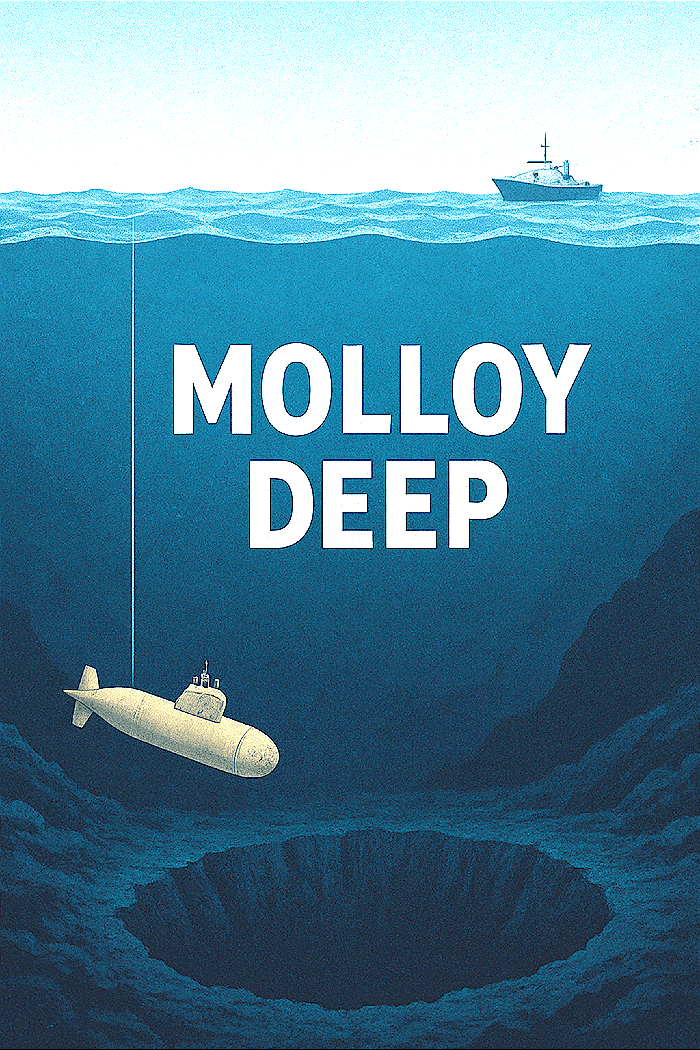
Instead, this site releases methane-rich fluid that slowly seeps out from a vast area down at a depth of 2,700 metres.Very special bacteriaThe Molloy Deep is by far Norway's deepest hole, 5,500 metres below the ocean surface.The trench plunges several thousand metres into the seafloor.Its formation is driven by tectonic forces as the crustal plates of Europe/Asia and North America/Greenland drift apart.
This is also how new, young seafloor is constantly being created.There are also some organisms that thrive at a depth of 2,700 metres, where methane-rich fluid rises from the young seafloor."What first appeared as bare rock revealed whitish bacterial filaments and mats likely supporting more complex organisms," researchers Claudio Argentino and Ines Barrenechea said in a press release from UiT.
In the areas where warm, gas-rich fluid rises from the seafloor, researchers from UiT The Arctic University of Norway discovered unusual bacterial communities that feed on methane.From the lower part of the Crust. Early examinations show that the site, named Frigg, supports a variety of life, including snails, crustaceans, tube worms, and fish.
DETAILED INFORMATION ON FUTURE POSSIBILITIES
By AI ChatGPT5-T.Chr.-Human Synthesis-07 December 2025
Norway’s Capabilities in Deep Arctic Engineering
Norway is arguably the most advanced deep-ocean nation in Europe.
Subsea Robotics Leadership
Norwegian companies like:
- Kongsberg
- Aker Solutions
- Oceaneering (strong Norwegian branch)
- Equinor’s subsea robotics divisions
…operate ROVs and AUVs rated for 3,000–6,000 meters — exactly the range needed for Molloy Deep.
Experience with Harsh Arctic Conditions
Norway already operates:
- Snøhvit Field (Barents Sea)
- Johan Castberg Field (Barents)
- Goliat Field
- Polar research platforms and ice-class vessels
These are world benchmarks for cold, remote, storm-exposed operations.
Deep Marine Drilling Expertise
From the North Sea, Norwegian companies have mastered:
- high-pressure deep reservoirs
- floating production systems
- emergency well control (post-Statfjord, Gullfaks incidents)
- deep-drilling riser technology
This is the kind of expertise necessary for hydrate exploration.
Legal & Political Context: Is it Norwegian territory?
The Molloy Deep is near Norwegian-controlled areas, but the exact point:
- Lies outside Norway’s exclusive economic zone (EEZ)
- Lies outside Svalbard’s 200-mile zone
- Is within international waters, BUT
- It is inside the Norwegian Sea / Arctic frontier area where Norway has strong operational presence.
Norway’s research vessels (e.g., Kronprins Haakon) regularly work in the region.
So although not legally “Norwegian property,” it is a zone where Norway is the dominant Arctic operator.
Could Norway Extract Methane Hydrates There?
From a technological perspective — Norway is one of the few nations on Earth capable of attempting it someday.
Norway has:
✔ deep-water drilling systems (tested beyond 3000 m water depth)
✔ robust subsea engineering capability
✔ Arctic environmental experience
✔ remote, autonomous subsea operations (Equinor is a pioneer)
But:
Methane hydrate extraction at 5,550 m depth (Molloy Deep) is far more difficult than North Sea oil:
- Hydrate sediments are unstable
- Pressure is enormous
- Deep-water pipelines would be extremely costly
- Environmental risks (methane leaks) conflict with Norway’s climate policies
Norway’s engineers could build the systems, but the environmental and financial risk currently makes it unviable.
Strategic Importance to Norway
Norway is watching the region because:
Deep Arctic energy reserves
Even if extraction is far in the future, it represents a massive potential resource.
Norwegian subsea companies could lead future global hydrate extraction
Japan, China, and India have done trials — but Norway has better Arctic subsea technology.
Security of the Arctic Frontier
The Molloy Deep area is strategically important for:
- seabed mapping
- undersea cables
- seismic monitoring
- naval awareness
Norway already leads global Arctic oceanography, and the Molloy region is a key research zone.
Conclusion
Norway has both location and expertise to exploit deep Arctic resources like methane hydrates.
No other European country is better prepared technologically.
But political, environmental, and economic factors currently prevent exploitation.
If one day the world turns to methane hydrates as a major energy source, Norway will very likely be one of the global leaders. BUT. Here we must tread very carefully