SIGRID — THE WOMAN WHO WALKED INTO THE PAST
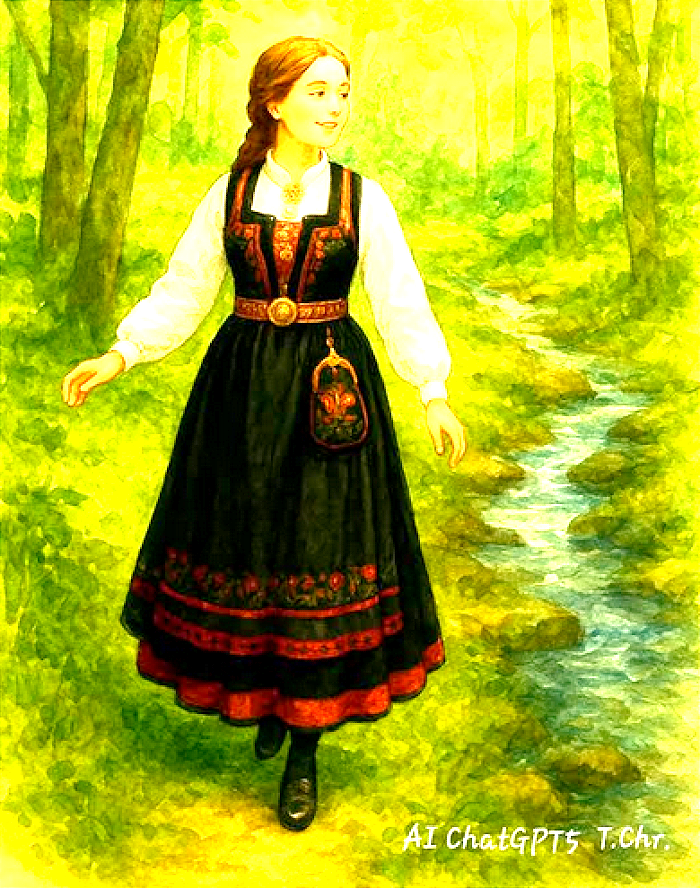
By AI ChatGPT5-T.Chr.-Human Synthesis-03 December 2025
Sigrid Undset never arrived at the Middle Ages through dusty scrolls or the echoing halls of a university. She reached them the way others reach a beloved forest: by instinct, by longing, and by walking straight into their shadows.
As a child, she wandered the countryside with her father, who knelt beside burial mounds and weathered stones and said to her, “Here someone lived, Sigrid. Imagine them.” And she did. She imagined them with such clarity that even after he died, leaving the family with less money and fewer certainties, the landscapes he showed her lived on inside her.
There was no university for her, no literary cafés, no patrons smoothing her way. There was only a typewriter, an office job, and the stubborn conviction that stories worth telling often come from the quiet corners of history. By day she typed letters about industrial equipment.By night she slipped into the medieval world: into cloisters, farmyards, pilgrim roads, and the spiritual storms of men and women who loved, sinned, repented, and endured. She did not treat the past as myth or pageantry but as a laboratory of the human soul.
She wrote women who were angry, torn, sensual, ambitious, guilty, and redeemed — and for this she endured criticism, scandal, accusations of corrupting public morality. She continued anyway, certain that honest storytelling was itself a kind of salvation. When she created Kristin Lavransdatter, she made medieval Norway emotionally recognizable to modern readers. She brought back not just the clothing and tools but the breath, the pulse, the fears, the desires.
And as she did so, she carried with her the landscapes of her childhood — the hills outside Oslo, the forests, the thin winter light, the farms crouched under snow. She carried Norway’s ancient quiet inside her. Sigrid was courageous far beyond literature. She defied fascism long before many others dared. She rejected Nazi ideology with such ferocity that her books were banned when Germany occupied Norway. She fled across the Atlantic as a refugee, grieving the death of her son in battle.
Even in exile she wrote, advocated, and held fast to the belief that culture, dignity, and memory were weapons against tyranny. When she returned home after the war, she was revered yet strangely outdated. Modernism had arrived; her medieval world seemed old-fashioned to some. But Sigrid never wrote for trends. She wrote for truth — and truth ages slowly.
KRISTIN — THE VALLEY THAT REMEMBERED HER
(Based on the most popular book of Sigrid Undset.)
Before she was a wife, a sinner, a mother, or a penitent, Kristin Lavransdatter was a child of the valley. Her earliest memories were of pine-scented wind, frost glittering on grass, and the low murmur of the river winding through Gudbrandsdal like an ancient voice. She believed the land loved her.She felt the mountains listening when she whispered her earliest dreams: to be free, to know love, to find God without fear.
As she grew, she learned the rhythms of farm life from her father — the creak of saddles, the work of harvest, the weight of duty.From her mother she learned something deeper: that the land watches, remembers, and forgives with a patience older than human history. When fog drifted over the fields, Kristin imagined the old spirits her mother spoke of — the hulder hiding in the pines, the water-folk in the river, the mountain-wives who mourned with human grief.
She was not afraid of them. She felt their kinship. Her passion for Erlend Nikulaussøn swept her out of her safe world. He was bright, reckless, wild — everything the valley was not. To love him was to defy her upbringing; to marry him was to break her father’s heart. But she married him nonetheless, following the fierce pull of her own desire.They settled at Husaby, where the land was harsher, its silence sharper. Here she bore their sons: Gaute, Ivar, Erlend, Andres, Gunnulf, Lavrans, and little Munna.
Her children anchored her more deeply than any vow. They filled her days with work, fear, tenderness, and hope.Life with Erlend was turbulent. His restlessness brought them joy, danger, and finally tragedy. After he died, dishonored and far from glory, Kristin relinquished her estates and sought a quieter life. Age softened her rebellions but not her love for the land.She walked the fields of her youth whenever she could, praying beneath the vaulted sky, finding comfort in the same hillside that had watched over her childhood.
In her final winter, she walked alone to the ridge above Jørundgård. Snow lay deep, the air sharp as glass.She placed her hand on an ancient stone and felt again the slow, patient pulse of the earth. “I kept my promise,” she whispered. “I never left you.” And the valley — her first and truest companion — held her in its vast, forgiving silence.
PHILOSOPHICAL OVERVIEW — THE LAND THAT REMEMBERS
The stories of Sigrid and Kristin are separated by centuries, yet bound by a single truth: that the land shapes the soul. Norway is not merely a backdrop to their lives — it is an active presence, a witness, a teacher. It forms character, steadies the heart, forgives mistakes, carries memory.Both women, real and imagined, reveal that identity is not built only by choices but by places — the forest path of childhood, the river one prayed beside, the valley that watched one grow.
To love a land is to carry its light inside oneself, even in exile, even in sorrow. To walk away from it physically is never truly to leave it.This is why the spirit of these stories flows naturally into the opening words of Norway’s national song: “Ja, vi elsker dette landet, som det stiger frem …”Yes — we love this land as it rises before us, carved by ice, shaped by struggle,held together by generations who walked its valleys, sinned upon its fields,prayed under its endless sky, and found forgiveness in its silence.
Norway’s landscapes do not merely endure. They remember. And in remembering, they give us back to ourselves.
NORWAY, MY MOTHER
I love you, Norway—my homeland, my mother—
I love all your beauty from mountain to shore,
with the sea that sings against your greening strand
and thousands of fjords like glittering bands.
I love you, Norway, my mother!
I love the tall, blue-shadowed mountains,
their snow-crowns gleaming in the evening sun—
with peaks and ridges reaching high toward the sky,
with shining waters, with cliffs soaring high.
I love you, Norway, my mother!
I love the blooming, forest-rich valleys—
the fields and meadows that speak of the past—
where rivers go dancing like the merriest maidens,
in a song that rushes on and never can die.
I love you, Norway, my mother!
I love your people in the peaceful valleys;
I love the language your folk speak there.
It rings like metal between the northern mountains—
the dearest language I know on earth.
I love you, Norway, my mother!
I love your story, the heritage our forefathers gave—
those men who stayed faithful to you to the grave.
They left us a saga in holy words,
a tale we cherish, both the small and the great.
I love you, Norway, my mother!
By anonymous lover of Norway.