THE MAASAI PEOPLE OF KENYA
By AI ChatGPT5 - T.Chr.-Human Synthesis-03 December 2025
History, origins and culture of the Maasai people of Kenya (and northern Tanzania) — based on historical, anthropological and oral-tradition sources.
Origins and Migration
- The Maasai are originally a Nilotic (or Nilo-Saharan) group. Their ancestors lived in the region north of Lake Turkana — in what corresponds to the lower Nile Valley / South Sudan area. World History Encyclopedia+2Wikipedia+2
- Sometime around the 15th–16th centuries, the Maasai began a southward migration. Masai Mara Website+2Google Arts & Culture+2
- Over the 17th and 18th centuries they settled broadly across what today is southern Kenya and northern–central Tanzania, adapting to the savanna and Rift-Valley environment. Masai Mara Website+2World History Encyclopedia+2
- By the 19th century, their territory — often called “Maasailand” — reached its peak: the Maasai dominated a large expanse of the Great Rift Valley and adjacent lands, from regions near Mount Marsabit in the north down toward central Tanzania (as far as Dodoma) in the south. Wikipedia+2The African History+2
Because of this migration and expansion, the Maasai replaced, displaced, or assimilated various earlier inhabitants (many of them Southern Cushitic groups), altering the demographic and ethnic landscape of large parts of East Africa. Wikipedia+2Safari Avventura - Safari in Tanzania+2
Lifestyle, Social Structure and Culture
- The Maasai are traditionally semi-nomadic pastoralists whose lives center around their cattle. Cattle are more than livestock: they are their main source of food (milk, meat, blood), wealth, social status, and identity. Masai Mara National Reserve+2World History Encyclopedia+2
- Their dwellings — enkangs / manyattas — are simple, circular homesteads made of locally available materials (mud, sticks, grass, cow dung), often enclosed by thorn-bush fences (kraals) to protect livestock from predators. Encyclopedia Britannica+2Google Arts & Culture+2
- The Maasai society is patriarchal. Social organization is strongly built around age-sets: individuals of similar age are initiated at the same time, and progress through life stages as a group — from youths to warriors, then elders. Encyclopedia Britannica+2World History Encyclopedia+2
- Young men — known as “morans” (warriors) — historically went through rigorous initiation (including circumcision) and training: learning survival, endurance, tribal laws, and warrior skills. For centuries they were known as formidable cattle-raiders and defenders of Maasai territory. Encyclopedia Britannica+2Masai Mara+2
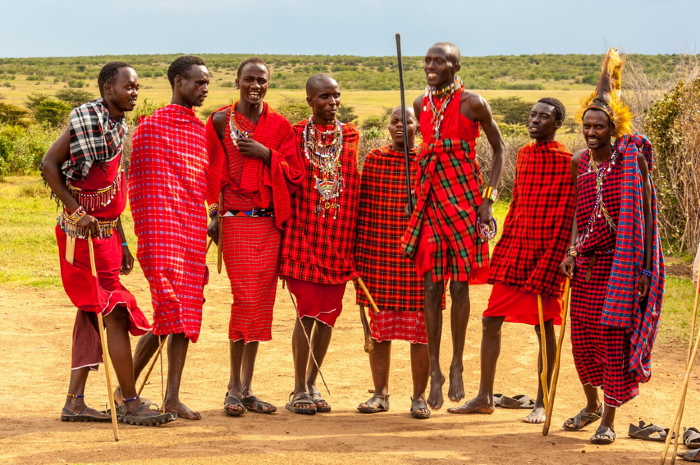
- The Maasai also have rich cultural traditions: distinctive dress (often colourful shúkà cloths), beadwork used in jewelry and symbolic adornment, and expressive customs. Music and dance — especially their famous “jumping dance” — are well-known aspects of their identity. Masai Mara National Reserve+2Masai Mara National Reserve+2
DANCING MASSAI LADIES
Religiously/spiritually, the Maasai believe in a monotheistic deity, often called Enkai (or Engai), and their worldview connects cattle, land, and spiritual blessings: to them, cows are not just property, but gifts from Enkai — which shapes their relationship to livestock and land. Masai Mara National Reserve+2Safari Avventura - Safari in Tanzania+2
Historical Challenges: Expansion, Conflict, and Displacement
- As the Maasai expanded over the centuries, they often displaced or assimilated earlier communities. Their dominance in large swathes of East Africa (Great Rift Valley and beyond) was built on mobility, cattle herding, and warrior prowess. World History Encyclopedia+2Wikipedia+2
- However, by the late 19th and early 20th centuries — during the colonial era — their situation changed drastically. Colonial powers (especially British authorities) pressured, negotiated, and enforced treaties that stripped the Maasai of much of their ancestral land. Between treaties in 1904 and 1911, the Maasai lost a significant portion of their territory, being forced into less fertile, more arid lands. Masai Mara+2Masai Mara Website+2
- Later, in Tanzania, more Maasai lands were taken in the 1940s to create national parks and wildlife sanctuaries (e.g. near Serengeti, Ngorongoro, Manyara, Tarangire). Wikipedia+2Masai Mara Website+2
- These displacements severely impacted their traditional pastoralist lifestyle — reducing grazing land, fragmenting communities, and forcing many Maasai to reconsider the viability of their semi-nomadic life. Masai Mara Website+2World History Encyclopedia+2
Modern Challenges and Adaptations
- Today, many Maasai face pressure from land loss — due to conservation efforts, the creation of parks/reserves, expanding agriculture, and urbanization. This affects their access to traditional grazing lands and disrupts pastoral routes. Masai Mara National Reserve+2Masai Mara Website+2
- Climate change — shifting rainfall patterns and increasing droughts — also threatens their livestock-based livelihood, making cattle herding more difficult than in the past. Masai Mara National Reserve+1
- In response, some Maasai have adapted: many now combine traditional herding with modern occupations — for example, working as guides, in tourism (near game reserves), or engaging in commerce, selling livestock products or crafts. MAASAI ASSOCIATION+2Masai Mara National Reserve+2
- Despite these pressures, many Maasai continue to preserve and cherish their traditions: cultural ceremonies, beadwork and dress, social structure via age-sets, and their identity as guardians of land and cattle — although the form and context of their lives have shifted. Masai Mara National Reserve+2World History Encyclopedia+2
Significance — Why the Maasai Matter
The history of the Maasai is more than a story of migration and survival. It highlights:
- Adaptability and resilience: from migrating ancient roots to surviving colonial dispossession and modern pressures.
- A different relationship to land and animals: where cattle are not commodified but integral to identity, spirituality and community life.
- Cultural continuity despite change: The Maasai remain one of East Africa’s most distinctive ethnic groups — their traditions, language, social structure and lifestyle continue, even as the world around them changes.
- Challenges for indigenous peoples globally: Their story reflects broader issues — land rights, displacement, cultural erosion — faced by many traditional communities.
Lenana (c. 1860–1911)
Laibon (spiritual leader) of the Maasai during the colonial era
Lenana, also known as Ole Lenana, was one of the most influential Maasai leaders of the late 19th and early 20th centuries. He served as the Laibon — the spiritual guide and political mediator of the Maasai — during one of the most turbulent periods in the community’s history.
Early Life
- Born around 1860, son of the powerful Laibon Mbatian.
- Grew up during the height of Maasai territorial expansion across the Rift Valley.
- Trained in traditional ritual knowledge, prophecy, healing, and spiritual leadership.
Rise to Power
When Mbatian died in the early 1890s, a succession conflict broke out between Lenana and his older brother Senteu.
- Lenana ultimately won support from many clans and succeeded as Laibon.
- The conflict weakened the Maasai at a time when European colonial powers were pushing into Kenya.
Role During Colonial Era
Lenana led the Maasai during:
- The Emutai disasters (rinderpest, smallpox, drought), which devastated cattle and population.
- The arrival and expansion of British colonial rule.
- Increasing pressure on Maasai lands.
Lenana is often remembered for signing agreements with the British, including:
- The 1904 Maasai Agreement
- The 1911 Maasai Move Agreement
These treaties forced the Maasai to relocate from their fertile ancestral lands in central Kenya to southern reserves.
Some view Lenana as a pragmatist who tried to preserve his people under impossible circumstances; others see the agreements as tragic losses forced by the colonial regime.
Legacy
- Lenana is one of the most documented Maasai leaders of the 19th century.
- Mount Lenana, one of the peaks of Mount Kenya, is named after him.
- He is remembered as a leader who guided the Maasai through catastrophe, war, and colonial displacement.
- His decisions — whether strategic or reluctant — shaped the future of the Maasai for generations.
Timeline of the Maasai People
Before 1500 — Origins
- Pre-1500: Ancestors of the Maasai lived in the lower Nile Valley / South Sudan region, part of the wider Nilotic migrations.
- They were pastoralists whose culture revolved around cattle long before reaching Kenya and Tanzania.
1500–1700 — Southward Migration
c. 1500–1600: Maasai groups migrate south from the Nile region toward present-day northern Kenya.
- 1600–1700: They settle around Lake Turkana, then move further down the Rift Valley.
1700–1850 — Expansion Across East Africa
- 18th century: Rapid Maasai expansion into central and southern Kenya.
- They displace or absorb earlier Cushitic peoples in the Rift Valley.
- Early 19th century: Maasai reach their widest territory, stretching:
- From central Kenya down to northern/central Tanzania
- West towards the Serengeti and east toward Tsavo.
This period is sometimes called the “Maasai Age of Power.”
1850–1890 — Crises and “The Maasai Emutai”
- 1880s–1890s: A devastating era called Emutai (“the wiping out”):
- Rinderpest cattle plague killed up to 90% of their herds.
- Severe drought destroyed grazing lands.
- Smallpox decimated the population.
- Famine followed.
The combination of these catastrophes weakened Maasai power just as European colonialism intensified.
1904 & 1911 — Land Loss Under British Rule
- 1904: First treaty with the British — Maasai forcibly removed from their fertile central Kenyan lands to the south.
- 1911: Second agreement — further displacement into limited reserves (e.g., Ngong, Laikipia, and parts of Kajiado).
These two treaties caused the Maasai to lose the majority of their ancestral territory.
1920–1960 — Colonial Restrictions
- Under British rule in Kenya and German/British rule in Tanzania:
- Movement was restricted.
- Traditional grazing routes were blocked.
- Areas later became national parks, especially in Tanzania (e.g., Serengeti, Ngorongoro).
This prevented long-distance cattle migration and altered their traditional pastoral lifestyle.
1960–1990 — Post-Independence Pressures
- After Kenya (1963) and Tanzania (1961) became independent:
- The Maasai asked for land rights restoration — mostly denied.
- New conservation areas continued to reduce grazing territory.
- Some Maasai began entering schooling, business, military or tourism work.
1990–Present — Modern Challenges and Cultural Strength
- Land disputes continue, especially where wildlife reserves or developers expand.
- Climate change makes droughts more frequent, affecting cattle.
- Education and modern employment are increasing among Maasai youth.
- Cultural preservation efforts grow:
- beadwork traditions
- age-set ceremonies
- use of Maa language
- community-led conservation.
Despite changes, the Maasai remain one of East Africa’s strongest cultural identities.