Death toll passes 1,100 in devastating floods across Indonesia, Sri Lanka, Malaysia and Thailand – latest updates
By Guardian - Rebecca Ratcliff - 10.30 - GMT 13.50
Hundreds remain missing in Indonesia and Sri Lanka as rescue efforts continue after Cyclone Ditwah. How cyclones and monsoon rains combined to devastate parts of Asia.
14m ago
- 1h agoDeath toll rises to 593 in Indonesia, officials say, meaning Asia floods death toll passes 1,100
- 2h agoIs human-caused climate breakdown making floods worse? How do we adapt to flooding?
- 3h agoIndonesian government criticised for what many see as an ill-prepared disaster response
- 4h agoSri Lanka death toll increases to 355, officials say in update
- 4h agoDesperate search for survivors as Asia flood toll exceeds 1,000
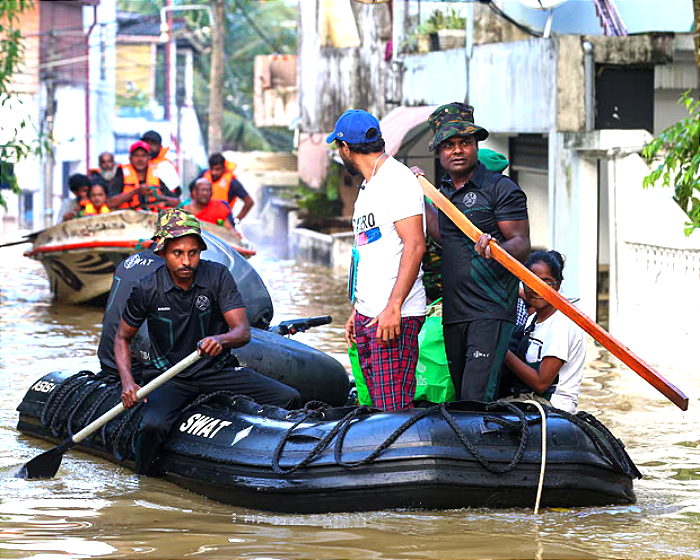
Sri Lankan special task force soldiers rescue residents from flood-affected areas after heavy rains from Cyclone Ditwah sweep through Colombo. Photograph: Krishan Kariyawasam/NurPhoto/Shutterstock
Death toll rises to 593 in Indonesia, officials say, meaning Asia floods death toll passes 1,100
The death toll from the devastating floods and landslides in Indonesia has risen to 593 (up from 502), the national disaster agency has reported in an update, as rescue workers continue to battle to reach affected areas.
It said 468 people were missing, while more than 578,000 others were evacuated from homes across three provinces on the western Indonesian island of Sumatra.
The Indonesian death toll revision mean that the toll in deadly flooding and landslides across Indonesia, Thailand (176 deaths), Sri Lanka (355 deaths) Malaysia (three deaths) climbed past 1,100 on Monday.
The death toll in Indonesia from the floods and landslides has risen again, to 604, the country’s disaster mitigation agency said. Another 464 people are still reported to be missing.
Electricity supply in West Sumatra is being restored, but power in North Sumatra and Aceh remains disrupted, Al Jazeera has quoted the deputy minister of energy and mineral resources Yuliot Tanjung as having said.
Death toll rises to 593 in Indonesia, officials say, meaning Asia floods death toll passes 1,100
The death toll from the devastating floods and landslides in Indonesia has risen to 593 (up from 502), the national disaster agency has reported in an update, as rescue workers continue to battle to reach affected areas.
It said 468 people were missing, while more than 578,000 others were evacuated from homes across three provinces on the western Indonesian island of Sumatra.
The Indonesian death toll revision mean that the toll in deadly flooding and landslides across Indonesia, Thailand (176 deaths), Sri Lanka (355 deaths) Malaysia (three deaths) climbed past 1,100 on Monday.
The UN office for the coordination of humanitarian affairs (OCHA) has warned of the strains the flooding in Sri Lanka is putting on the country’s already fragile health system.
In an update posted yesterday, the OCHA said several district hospitals were flooded and are receiving only basic supplies. Critically ill patients had to be airlifted to functioning hospitals to continue treatment, it added.
Separately, the World Health Organization (WHO) has said flooding significantly increases the risk of food/water/vector-borne diseases, urging people to use safe drinking water, ensure food hygiene and protect against mosquito bites when possible.
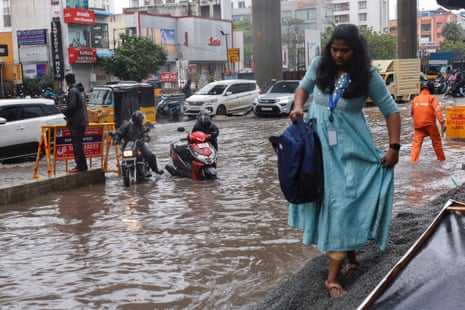
Cyclone Ditwah, which unleashed catastrophic flooding and landslides across Sri Lanka, has brought heavy rain to India’s southern state of Tamil Nadu.
The storm, now about 30 miles off the coast of the city of Chennai, the state capital, has weakened into a “deep depression”, according to weather officials, who expect it to weaken even further across the day.
This interactive shows how warm seas contribute to cyclone frequency and strength:
Is human-caused climate breakdown making floods worse? How do we adapt to flooding?
The climate crisis has affected storm patterns, including the duration and intensity of the annual monsoon season, leading to heavier rainfall, flash flooding and stronger wind gusts. The Guardian’s Europe environment correspondent, Ajit Niranjan, has written this useful explainer on the impacts, human causes and affects of flooding generally, and outlines what effective adaptation/management looks like. Here is an extract from the piece:
The burning of fossil fuels has heated the planet, increasing the risk of extreme rains that lead to floods around the world, particularly in Europe, most of Asia, central and eastern North America, and parts of South America, Africa and Australia. A well-established rule of physics is that warm air can hold more moisture – about 7% for every 1C – though whether it does so or not depends on how much water is available. When heavy rain does fall, clouds can unleash far more water.
Perhaps surprisingly, a lack of water can also worsen floods, by drying out the ground. Hard, caked soil does not absorb water so it runs off and pools in lower-lying regions, allowing water levels to rise much faster than otherwise.
Flooding is also affected by human factors such as the existence of flood defences and land use …
Globally, the biggest progress in saving lives has come from early warning systems that alert people to danger and help them escape before it strikes …
Building dykes and retention basins can limit the damage from heavy rainfall. In cities, parks and other green spaces can also soak up rain before it turns into a flood. On coasts, sea walls can keep the waters out.
But scientists warn there are limits to adaptation as the planet heats up. They increasingly talk about “managed retreat” to permanently move people out of harm’s way – a route that some communities around the world have already gone down. This can mean abandoning homes, towns and, in the case of small island states being submerged by the sea, entire countries.
Rebecca Ratcliffe
In Thailand, the deputy prime minister, Thamanat Prompow, visited Hat Yai, one of the worst-affected areas, on Monday. He said provincial water and electricity authorities had been ordered to restore services immediately and that solar lamps were being distributed.
Local media reported that 80% of people in Hat Yai had returned home from evacuation centres to survey the damage, and recovery and cleanup operations were under way.
People in Hat Yai have been urged to register for 9,000 baht (£215) compensation from the government, while a interest-free loan of 100,000 baht will also be made available.
The region’s monsoon season often brings heavy rains that can cause landslides and flash floods, but recent flooding in south-east Asia has been exacerbated by a rare tropical storm formed in the Malacca strait.
Human-caused climate breakdown has increased the occurrence of the most intense and destructive tropical cyclones, though the overall number per year has not changed globally. This is because warming oceans provide more energy, producing stronger storms. Extreme rainfall from tropical cyclones has increased substantially, as warmer air holds more water vapour.
You can read the full story here:
The floods in Thailand have killed more than 170 people across eight southern provinces. The southern Songkhla province has reported the most deaths.
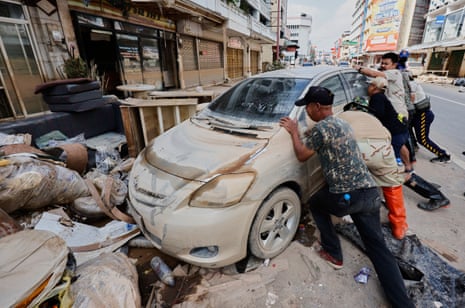
The flooding, which began just over a week ago, has caused severe disruptions, leaving thousands of people stranded, rendering streets impassable and submerging low-rise buildings and vehicles.
Relief measures rolled out by the Thai government include compensation for households that lost family members, debt suspension and short-term, interest-free loans for businesses and home repairs.
But, as my colleague Angelique Chrisafis notes in this story, there has been growing public criticism of Thailand’s flood response, and two local officials have been suspended over their alleged failures.
Emergency workers in Indonesia have found it difficult reaching many residents, especially those in areas cut off by landslides and collapsed bridges.
Authorities have particularly struggled to reach two cities hit hard by the flooding in North Sumatra: Central Tapanuli and Sibolga.
Indonesian government criticised for what many see as an ill-prepared disaster response
Now turning to Indonesia, where public anger is mounting over what many say was an ill-prepared governmental response to the deadly floods.
Cyclone Senyar, which formed over the Malacca Strait, a stretch of water connecting the Indian Ocean and the South China Sea, made landfall last Wednesday, unleashing heavy rainfall that triggered flash floods and landslides in North Sumatra before continuing its devastating path in Aceh and West Sumatra.
As we reported in the opening summary, the death toll from the floods in Indonesia stands at 502, official data showed on Monday. About 508 people are missing and 2,500 others injured.
Some areas of Indonesia remain unreachable after the disaster damaged roads and communications lines, with residents in affected areas relying on aircraft delivering supplies.
Although the easing of rainfall over the past two days is a welcomed sign, many people have not received food aid and are reportedly struggling to access clean water. There have been some reports of looting in districts in Aceh and North Sumatra, amid scenes of desperation.
Indonesian President Prabowo Subianto has come under pressure to declare a national emergency in response to flooding and landslides. Unlike his Sri Lankan counterpart, he has also not publicly called for international assistance. The sluggish delivery of food aid has been blamed by many on unnecessary bureaucratic hurdles.
The Sri Lankan president, Anura Kumara Dissanayake, declared a state of emergency on Saturday to deal with the aftermath of Cyclone Ditwah and appealed for international aid. He called it the “most challenging natural disaster” Sri Lanka has seen.
The extreme weather system had, as of Sunday, destroyed more than 25,000 homes and forced 147,000 people into state-run temporary shelters. A further 968,000 people required assistance after being displaced by the floods.
The cyclone is Sri Lanka’s deadliest extreme weather disaster since 2017, when flooding and landslides claimed more than 200 lives and displaced hundreds of thousands of people.
Record rains hit he country from last Thursday causing multiple landslides in the hilly central region while overflowing rivers submerged entire towns.
Over 24,000 police, army and air force personnel are still trying to reach families stranded by floods, authorities said, with several countries having sent in aid to help with relief efforts, notably India and Japan.
Sri Lanka death toll increases to 355, officials say in update
The death toll in Sri Lanka has increased to 355, the country’s disaster management center said in its latest situation report, adding that another 366 people were missing.
Most of the deaths (88) occurred in the city of Kandy, followed by the central mountainous tea-growing regions of Nuwara Eliya (75) and Badulla (71), according to the officials.
Desperate search for survivors as Asia flood toll exceeds 1,000
The flooding and landslides that have devastated parts of Thailand, Malaysia, Indonesia and Sri Lanka over recent days have killed more than 1,000 people, according to authorities.
The death toll for the floods in Indonesia has risen to 502, the national disaster management agency has said in a new update, with another 508 people missing.
At least 340 people have been killed in Sri Lanka, officials said on Monday, with many more still missing. Flood waters in the capital, Colombo, peaked overnight, and with rain now stopped there were hopes that waters would begin receding.
Sri Lanka and Indonesia have deployed military personnel to help victims of the catastrophic flooding as rescue workers race to reach possible survivors in some of the hardest hit areas.
Flooding has killed at least 176 people in southern Thailand, according to officials, one of the deadliest flood incidents in the country in a decade.
Across the border, at least two deaths have been reported in Malaysia’s northern Perlis state. Stay with us as we give you the latest developments from the region.
Explore more on these topics
Death toll rises to 593 in Indonesia, officials say, meaning Asia floods death toll passes 1,100
The death toll from the devastating floods and landslides in Indonesia has risen to 593 (up from 502), the national disaster agency has reported in an update, as rescue workers continue to battle to reach affected areas.
It said 468 people were missing, while more than 578,000 others were evacuated from homes across three provinces on the western Indonesian island of Sumatra.
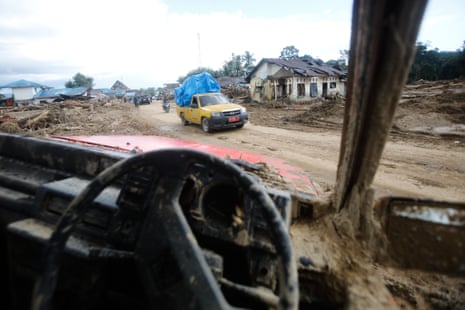
A view through the wreckage of a car at a village affected by a flash flood in Batang Toru in North Sumatra, Indonesia. Photograph: Binsar Bakkara/AP
The Indonesian death toll revision mean that the toll in deadly flooding and landslides across Indonesia, Thailand (176 deaths), Sri Lanka (355 deaths) Malaysia (three deaths) climbed past 1,100 on Monday.
The death toll in Indonesia from the floods and landslides has risen again, to 604, the country’s disaster mitigation agency said. Another 464 people are still reported to be missing.
Electricity supply in West Sumatra is being restored, but power in North Sumatra and Aceh remains disrupted, Al Jazeera has quoted the deputy minister of energy and mineral resources Yuliot Tanjung as having said.
Death toll rises to 593 in Indonesia, officials say, meaning Asia floods death toll passes 1,100
The death toll from the devastating floods and landslides in Indonesia has risen to 593 (up from 502), the national disaster agency has reported in an update, as rescue workers continue to battle to reach affected areas.
It said 468 people were missing, while more than 578,000 others were evacuated from homes across three provinces on the western Indonesian island of Sumatra.
A view through the wreckage of a car at a village affected by a flash flood in Batang Toru in North Sumatra, Indonesia. Photograph: Binsar Bakkara/AP
The Indonesian death toll revision mean that the toll in deadly flooding and landslides across Indonesia, Thailand (176 deaths), Sri Lanka (355 deaths) Malaysia (three deaths) climbed past 1,100 on Monday.
The UN office for the coordination of humanitarian affairs (OCHA) has warned of the strains the flooding in Sri Lanka is putting on the country’s already fragile health system.
In an update posted yesterday, the OCHA said several district hospitals were flooded and are receiving only basic supplies. Critically ill patients had to be airlifted to functioning hospitals to continue treatment, it added.
Separately, the World Health Organization (WHO) has said flooding significantly increases the risk of food/water/vector-borne diseases, urging people to use safe drinking water, ensure food hygiene and protect against mosquito bites when possible.
Cyclone Ditwah, which unleashed catastrophic flooding and landslides across Sri Lanka, has brought heavy rain to India’s southern state of Tamil Nadu.
The storm, now about 30 miles off the coast of the city of Chennai, the state capital, has weakened into a “deep depression”, according to weather officials, who expect it to weaken even further across the day.
People commute through a water-logged street in Chennai, India. Photograph: Priyanshu Singh/Reuters
This interactive shows how warm seas contribute to cyclone frequency and strength:
Is human-caused climate breakdown making floods worse? How do we adapt to flooding?
The climate crisis has affected storm patterns, including the duration and intensity of the annual monsoon season, leading to heavier rainfall, flash flooding and stronger wind gusts. The Guardian’s Europe environment correspondent, Ajit Niranjan, has written this useful explainer on the impacts, human causes and affects of flooding generally, and outlines what effective adaptation/management looks like. Here is an extract from the piece:
The burning of fossil fuels has heated the planet, increasing the risk of extreme rains that lead to floods around the world, particularly in Europe, most of Asia, central and eastern North America, and parts of South America, Africa and Australia. A well-established rule of physics is that warm air can hold more moisture – about 7% for every 1C – though whether it does so or not depends on how much water is available. When heavy rain does fall, clouds can unleash far more water.
Perhaps surprisingly, a lack of water can also worsen floods, by drying out the ground. Hard, caked soil does not absorb water so it runs off and pools in lower-lying regions, allowing water levels to rise much faster than otherwise.
Flooding is also affected by human factors such as the existence of flood defences and land use …
Globally, the biggest progress in saving lives has come from early warning systems that alert people to danger and help them escape before it strikes …
Building dykes and retention basins can limit the damage from heavy rainfall. In cities, parks and other green spaces can also soak up rain before it turns into a flood. On coasts, sea walls can keep the waters out.
But scientists warn there are limits to adaptation as the planet heats up. They increasingly talk about “managed retreat” to permanently move people out of harm’s way – a route that some communities around the world have already gone down. This can mean abandoning homes, towns and, in the case of small island states being submerged by the sea, entire countries.
Rebecca Ratcliffe
In Thailand, the deputy prime minister, Thamanat Prompow, visited Hat Yai, one of the worst-affected areas, on Monday. He said provincial water and electricity authorities had been ordered to restore services immediately and that solar lamps were being distributed.
Local media reported that 80% of people in Hat Yai had returned home from evacuation centres to survey the damage, and recovery and cleanup operations were under way.
People in Hat Yai have been urged to register for 9,000 baht (£215) compensation from the government, while a interest-free loan of 100,000 baht will also be made available.
Peoples move a car damaged by the flooding in Songkhla province, southern Thailand. Photograph: Sarot Meksophawannaku/AP
The region’s monsoon season often brings heavy rains that can cause landslides and flash floods, but recent flooding in south-east Asia has been exacerbated by a rare tropical storm formed in the Malacca strait.
Human-caused climate breakdown has increased the occurrence of the most intense and destructive tropical cyclones, though the overall number per year has not changed globally. This is because warming oceans provide more energy, producing stronger storms. Extreme rainfall from tropical cyclones has increased substantially, as warmer air holds more water vapour.
You can read the full story here:
The floods in Thailand have killed more than 170 people across eight southern provinces. The southern Songkhla province has reported the most deaths.
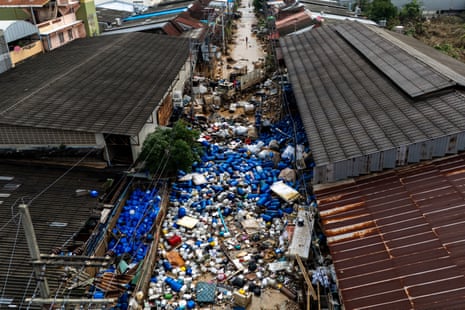
The flooding, which began just over a week ago, has caused severe disruptions, leaving thousands of people stranded, rendering streets impassable and submerging low-rise buildings and vehicles.
Relief measures rolled out by the Thai government include compensation for households that lost family members, debt suspension and short-term, interest-free loans for businesses and home repairs.
But, as my colleague Angelique Chrisafis notes in this story, there has been growing public criticism of Thailand’s flood response, and two local officials have been suspended over their alleged failures.
A drone view shows debris in a flooded area in Hat Yai district, Songkhla province, on 28 November 2025. Photograph: Athit Perawongmetha/ReutersShare3h ago09.44 GMT
Emergency workers in Indonesia have found it difficult reaching many residents, especially those in areas cut off by landslides and collapsed bridges.
Authorities have particularly struggled to reach two cities hit hard by the flooding in North Sumatra: Central Tapanuli and Sibolga.
Indonesian government criticised for what many see as an ill-prepared disaster response
Now turning to Indonesia, where public anger is mounting over what many say was an ill-prepared governmental response to the deadly floods.
Cyclone Senyar, which formed over the Malacca Strait, a stretch of water connecting the Indian Ocean and the South China Sea, made landfall last Wednesday, unleashing heavy rainfall that triggered flash floods and landslides in North Sumatra before continuing its devastating path in Aceh and West Sumatra.
As we reported in the opening summary, the death toll from the floods in Indonesia stands at 502, official data showed on Monday. About 508 people are missing and 2,500 others injured.
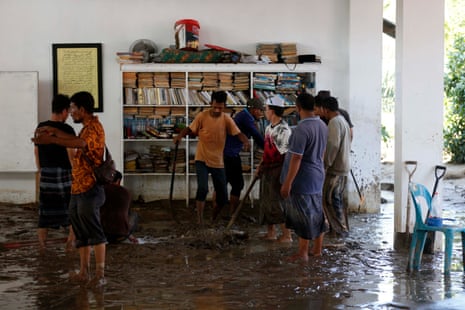
Residents clean up their houses in a flood-affected village in the Meureudu area, Pidie Jaya Aceh, Indonesia. Photograph: Hotli Simanjuntak/EPA
Some areas of Indonesia remain unreachable after the disaster damaged roads and communications lines, with residents in affected areas relying on aircraft delivering supplies.
Although the easing of rainfall over the past two days is a welcomed sign, many people have not received food aid and are reportedly struggling to access clean water. There have been some reports of looting in districts in Aceh and North Sumatra, amid scenes of desperation.
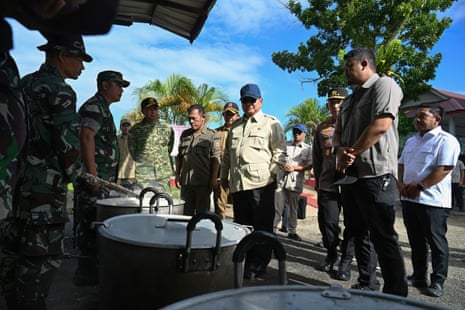
Indonesian President Prabowo Subianto has come under pressure to declare a national emergency in response to flooding and landslides. Unlike his Sri Lankan counterpart, he has also not publicly called for international assistance. The sluggish delivery of food aid has been blamed by many on unnecessary bureaucratic hurdles.
Indonesia’s President Prabowo Subianto (C) inspects the operation of a public kitchen preparing food for flash flood survivors at an evacuation post in Pandan, Central Tapanuli, in the North Sumatra province. Photograph: Yt Hariono/AFP/Getty ImagesShareUpdated at 09.21 GMT4h ago08.40 GMT
The Sri Lankan president, Anura Kumara Dissanayake, declared a state of emergency on Saturday to deal with the aftermath of Cyclone Ditwah and appealed for international aid. He called it the “most challenging natural disaster” Sri Lanka has seen.
The extreme weather system had, as of Sunday, destroyed more than 25,000 homes and forced 147,000 people into state-run temporary shelters. A further 968,000 people required assistance after being displaced by the floods.
The cyclone is Sri Lanka’s deadliest extreme weather disaster since 2017, when flooding and landslides claimed more than 200 lives and displaced hundreds of thousands of people.
Record rains hit he country from last Thursday causing multiple landslides in the hilly central region while overflowing rivers submerged entire towns.
Over 24,000 police, army and air force personnel are still trying to reach families stranded by floods, authorities said, with several countries having sent in aid to help with relief efforts, notably India and Japan.
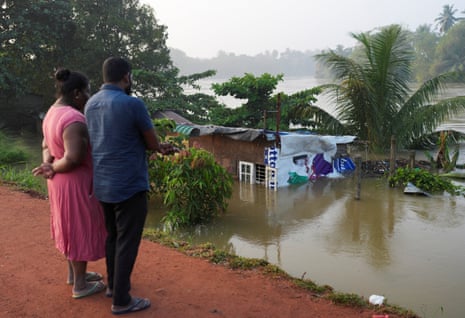
People look towards a house partially submersed by flooding in Peliyagoda, Sri Lanka. Photograph: Thilina Kaluthotage/ReutersShareUpdated at 09.48 GMT4h ago08.28 GMT
Sri Lanka death toll increases to 355, officials say in update
The death toll in Sri Lanka has increased to 355, the country’s disaster management center said in its latest situation report, adding that another 366 people were missing.
Most of the deaths (88) occurred in the city of Kandy, followed by the central mountainous tea-growing regions of Nuwara Eliya (75) and Badulla (71), according to the officials.
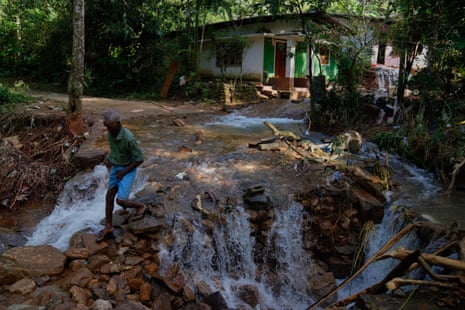
A landslide survivor crosses a section of a damaged road in Sarasavigama village in Kandy. Photograph: Eranga Jayawardena/APShareUpdated at 08.40 GMT4h ago08.18 GMT
Desperate search for survivors as Asia flood toll exceeds 1,000
The flooding and landslides that have devastated parts of Thailand, Malaysia, Indonesia and Sri Lanka over recent days have killed more than 1,000 people, according to authorities.
The death toll for the floods in Indonesia has risen to 502, the national disaster management agency has said in a new update, with another 508 people missing.
At least 340 people have been killed in Sri Lanka, officials said on Monday, with many more still missing. Flood waters in the capital, Colombo, peaked overnight, and with rain now stopped there were hopes that waters would begin receding.
Sri Lanka and Indonesia have deployed military personnel to help victims of the catastrophic flooding as rescue workers race to reach possible survivors in some of the hardest hit areas.
Flooding has killed at least 176 people in southern Thailand, according to officials, one of the deadliest flood incidents in the country in a decade.
Across the border, at least two deaths have been reported in Malaysia’s northern Perlis state. Stay with us as we give you the latest developments from the region.
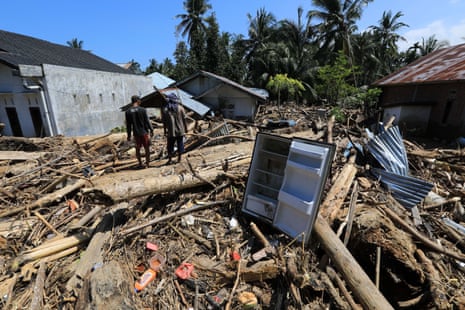
Residents walk among large piles of wood that were swept away by the flood waters in a village in the Meureudu area of Indonesia. Photograph: Hotli Simanjuntak/EPAShareExplore more on these topics
Death toll rises to 593 in Indonesia, officials say, meaning Asia floods death toll passes 1,100
The death toll from the devastating floods and landslides in Indonesia has risen to 593 (up from 502), the national disaster agency has reported in an update, as rescue workers continue to battle to reach affected areas.
It said 468 people were missing, while more than 578,000 others were evacuated from homes across three provinces on the western Indonesian island of Sumatra.
The Indonesian death toll revision mean that the toll in deadly flooding and landslides across Indonesia, Thailand (176 deaths), Sri Lanka (355 deaths) Malaysia (three deaths) climbed past 1,100 on Monday.
ShareUpdated at 12.04 GMT19m ago12.15 GMT
The death toll in Indonesia from the floods and landslides has risen again, to 604, the country’s disaster mitigation agency said. Another 464 people are still reported to be missing.
ShareUpdated at 12.21 GMT49m ago11.46 GMT
Electricity supply in West Sumatra is being restored, but power in North Sumatra and Aceh remains disrupted, Al Jazeera has quoted the deputy minister of energy and mineral resources Yuliot Tanjung as having said.
Death toll rises to 593 in Indonesia, officials say, meaning Asia floods death toll passes 1,100
The death toll from the devastating floods and landslides in Indonesia has risen to 593 (up from 502), the national disaster agency has reported in an update, as rescue workers continue to battle to reach affected areas.
It said 468 people were missing, while more than 578,000 others were evacuated from homes across three provinces on the western Indonesian island of Sumatra.
The Indonesian death toll revision mean that the toll in deadly flooding and landslides across Indonesia, Thailand (176 deaths), Sri Lanka (355 deaths) Malaysia (three deaths) climbed past 1,100 on Monday.
ShareUpdated at 12.04 GMT1h ago11.22 GMT
The UN office for the coordination of humanitarian affairs (OCHA) has warned of the strains the flooding in Sri Lanka is putting on the country’s already fragile health system.
In an update posted yesterday, the OCHA said several district hospitals were flooded and are receiving only basic supplies. Critically ill patients had to be airlifted to functioning hospitals to continue treatment, it added.
Separately, the World Health Organization (WHO) has said flooding significantly increases the risk of food/water/vector-borne diseases, urging people to use safe drinking water, ensure food hygiene and protect against mosquito bites when possible.
Cyclone Ditwah, which unleashed catastrophic flooding and landslides across Sri Lanka, has brought heavy rain to India’s southern state of Tamil Nadu.
The storm, now about 30 miles off the coast of the city of Chennai, the state capital, has weakened into a “deep depression”, according to weather officials, who expect it to weaken even further across the day.
ShareUpdated at 11.01 GMT2h ago10.44 GMT
This interactive shows how warm seas contribute to cyclone frequency and strength:
Is human-caused climate breakdown making floods worse? How do we adapt to flooding?
The climate crisis has affected storm patterns, including the duration and intensity of the annual monsoon season, leading to heavier rainfall, flash flooding and stronger wind gusts. The Guardian’s Europe environment correspondent, Ajit Niranjan, has written this useful explainer on the impacts, human causes and affects of flooding generally, and outlines what effective adaptation/management looks like. Here is an extract from the piece:
The burning of fossil fuels has heated the planet, increasing the risk of extreme rains that lead to floods around the world, particularly in Europe, most of Asia, central and eastern North America, and parts of South America, Africa and Australia. A well-established rule of physics is that warm air can hold more moisture – about 7% for every 1C – though whether it does so or not depends on how much water is available. When heavy rain does fall, clouds can unleash far more water.
Perhaps surprisingly, a lack of water can also worsen floods, by drying out the ground. Hard, caked soil does not absorb water so it runs off and pools in lower-lying regions, allowing water levels to rise much faster than otherwise.
Flooding is also affected by human factors such as the existence of flood defences and land use …
Globally, the biggest progress in saving lives has come from early warning systems that alert people to danger and help them escape before it strikes …
Building dykes and retention basins can limit the damage from heavy rainfall. In cities, parks and other green spaces can also soak up rain before it turns into a flood. On coasts, sea walls can keep the waters out.
But scientists warn there are limits to adaptation as the planet heats up. They increasingly talk about “managed retreat” to permanently move people out of harm’s way – a route that some communities around the world have already gone down. This can mean abandoning homes, towns and, in the case of small island states being submerged by the sea, entire countries.
ShareUpdated at 10.45 GMT2h ago10.06 GMT
Rebecca Ratcliffe
Rebecca Ratcliffe is the Guardian’s south-east Asia correspondent
In Thailand, the deputy prime minister, Thamanat Prompow, visited Hat Yai, one of the worst-affected areas, on Monday. He said provincial water and electricity authorities had been ordered to restore services immediately and that solar lamps were being distributed.
Local media reported that 80% of people in Hat Yai had returned home from evacuation centres to survey the damage, and recovery and cleanup operations were under way.
People in Hat Yai have been urged to register for 9,000 baht (£215) compensation from the government, while a interest-free loan of 100,000 baht will also be made available.
The region’s monsoon season often brings heavy rains that can cause landslides and flash floods, but recent flooding in south-east Asia has been exacerbated by a rare tropical storm formed in the Malacca strait.
Human-caused climate breakdown has increased the occurrence of the most intense and destructive tropical cyclones, though the overall number per year has not changed globally. This is because warming oceans provide more energy, producing stronger storms. Extreme rainfall from tropical cyclones has increased substantially, as warmer air holds more water vapour.
You can read the full story here:
The floods in Thailand have killed more than 170 people across eight southern provinces. The southern Songkhla province has reported the most deaths.
The flooding, which began just over a week ago, has caused severe disruptions, leaving thousands of people stranded, rendering streets impassable and submerging low-rise buildings and vehicles.
Relief measures rolled out by the Thai government include compensation for households that lost family members, debt suspension and short-term, interest-free loans for businesses and home repairs.
But, as my colleague Angelique Chrisafis notes in this story, there has been growing public criticism of Thailand’s flood response, and two local officials have been suspended over their alleged failures.
Emergency workers in Indonesia have found it difficult reaching many residents, especially those in areas cut off by landslides and collapsed bridges.
Authorities have particularly struggled to reach two cities hit hard by the flooding in North Sumatra: Central Tapanuli and Sibolga.
Indonesian government criticised for what many see as an ill-prepared disaster response
Now turning to Indonesia, where public anger is mounting over what many say was an ill-prepared governmental response to the deadly floods.
Cyclone Senyar, which formed over the Malacca Strait, a stretch of water connecting the Indian Ocean and the South China Sea, made landfall last Wednesday, unleashing heavy rainfall that triggered flash floods and landslides in North Sumatra before continuing its devastating path in Aceh and West Sumatra.
As we reported in the opening summary, the death toll from the floods in Indonesia stands at 502, official data showed on Monday. About 508 people are missing and 2,500 others injured.
Some areas of Indonesia remain unreachable after the disaster damaged roads and communications lines, with residents in affected areas relying on aircraft delivering supplies.
Although the easing of rainfall over the past two days is a welcomed sign, many people have not received food aid and are reportedly struggling to access clean water. There have been some reports of looting in districts in Aceh and North Sumatra, amid scenes of desperation.
Indonesian President Prabowo Subianto has come under pressure to declare a national emergency in response to flooding and landslides. Unlike his Sri Lankan counterpart, he has also not publicly called for international assistance. The sluggish delivery of food aid has been blamed by many on unnecessary bureaucratic hurdles.
The Sri Lankan president, Anura Kumara Dissanayake, declared a state of emergency on Saturday to deal with the aftermath of Cyclone Ditwah and appealed for international aid. He called it the “most challenging natural disaster” Sri Lanka has seen.
The extreme weather system had, as of Sunday, destroyed more than 25,000 homes and forced 147,000 people into state-run temporary shelters. A further 968,000 people required assistance after being displaced by the floods.
The cyclone is Sri Lanka’s deadliest extreme weather disaster since 2017, when flooding and landslides claimed more than 200 lives and displaced hundreds of thousands of people.
Record rains hit he country from last Thursday causing multiple landslides in the hilly central region while overflowing rivers submerged entire towns.
Over 24,000 police, army and air force personnel are still trying to reach families stranded by floods, authorities said, with several countries having sent in aid to help with relief efforts, notably India and Japan.
The death toll in Sri Lanka has increased to 355, the country’s disaster management center said in its latest situation report, adding that another 366 people were missing.
Most of the deaths (88) occurred in the city of Kandy, followed by the central mountainous tea-growing regions of Nuwara Eliya (75) and Badulla (71), according to the officials.
1,000 people, according to authorities.
The death toll for the floods in Indonesia has risen to 502, the national disaster management agency has said in a new update, with another 508 people missing.
At least 340 people have been killed in Sri Lanka, officials said on Monday, with many more still missing. Flood waters in the capital, Colombo, peaked overnight, and with rain now stopped there were hopes that waters would begin receding.
Sri Lanka and Indonesia have deployed military personnel to help victims of the catastrophic flooding as rescue workers race to reach possible survivors in some of the hardest hit areas.
Flooding has killed at least 176 people in southern Thailand, according to officials, one of the deadliest flood incidents in the country in a decade.
Across the border, at least two deaths have been reported in Malaysia’s northern Perlis state. Stay with us as we give you the latest developments from the region.

Rebecca Ratcliffe
Rebecca Ratcliffe is the Guardian’s south-east Asia correspondent
Original reporting and incisive analysis, direct from the Guardian every morning. Sign up for our email
© 2025 Guardian News & Media Limited or its affiliated companies. All rights reserved.(dcr, adapted)