Israeli airstrikes kill 33 people in Gaza in escalation of post-ceasefire attacks
By Guardian - Jason Burke in Jerusalem-Thu 20 Nov 2025 13.25 GMT
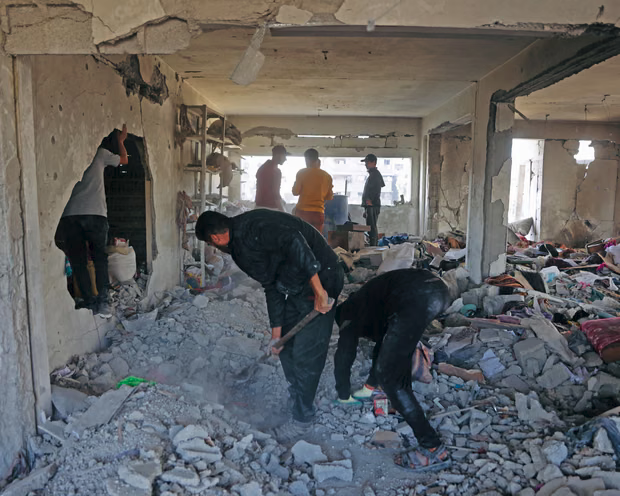
Medical officials say 17 people killed in Khan Younis area and 16 in strikes on Gaza City. Israeli attacks in Gaza have killed 33 people and injured many more, according to medical officials, in one of the most serious escalations of violence since the US-backed ceasefire came into effect last month.
Officials at Nasser hospital in Khan Younis said they received the bodies of 17 people, including five women and five children, after four Israeli airstrikes targeted tents sheltering displaced people. In Gaza City, medical officials said two airstrikes killed 16 people, including seven children and three women.
Israel said it launched the attacks after its soldiers came under fire in Khan Younis on Wednesday, though they suffered no reported casualties. Hamas condemned the Israeli strikes as a “shocking massacre” and denied firing toward Israeli troops.
Palestinians in Gaza said they felt as if the two-year war had never stopped. Officials in the territory say more than 300 people have been killed by Israeli strikes since the ceasefire.
“My daughter kept asking me all night, ‘Will the war come back?’ Every time we try to regain hope, the shelling starts again. When will this nightmare end?” Lina Kuraz, 33, from the Tuffah neighbourhood, east of Gaza City, told Agence France-Presse.
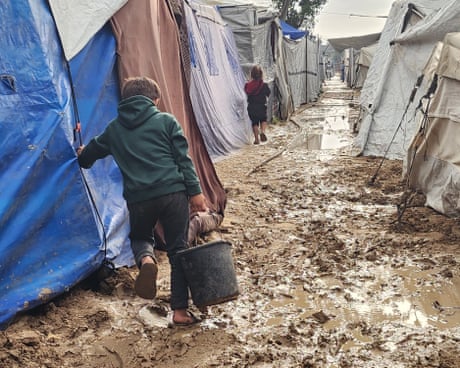
Mohammed Hamdouna, 36, who was displaced from northern Gaza to a tent in al-Mawasi, said the war had not ended. “The intensity of the death toll has decreased, but martyrs and shelling happen every day. We are still living in tents. The cities are rubble; the crossings are still closed, and all the basic necessities of life are still lacking,” he said.
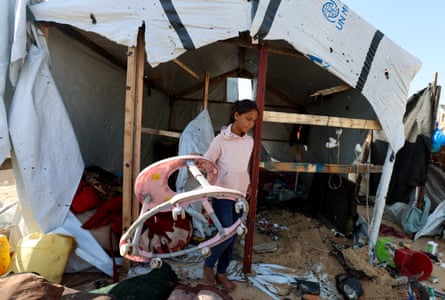
Israeli airstrikes on camps in al-Mawasi, Khan Younis, killed 17 people on Wednesday, hospital officials said. Photograph: Ramadan Abed/Reuters
Qatar, a key mediator throughout the two-year war, condemned the “brutal” Israeli airstrikes, saying they were “a dangerous escalation that threatens to undermine the ceasefire agreement”.
On Monday the UN security council endorsed Donald Trump’s plan for Gaza, including the deployment of an international stabilisation force and a possible path to a sovereign Palestinian state.
However, huge challenges remain. It is unclear how Hamas will be made to relinquish its weapons, who will supply the troops for the new peacekeeping force, and how “full aid” will reach Gaza without Israel lifting many of its current restrictions on humanitarian supplies.
Hamas is still holding the remains of three hostages, and Israeli military forces hold more than 50% of Gaza after withdrawing from some of their positions at the time of the ceasefire. The territory is now divided by the “yellow line”.
Gaza’s health ministry has reported more than 300 deaths since the ceasefire came into effect, an average of more than seven a day. Each side has accused the other of violating its terms, which include increasing the flow of aid into Gaza and returning hostages, dead or alive, to Israel.
The two-year war in Gaza was triggered when Hamas-led militants killed about 1,200 people, mostly civilians, and abducted 251 during a surprise attack into Israel in October 2023. More than 69,000 Palestinians, mostly civilians, were killed in the ensuring Israeli offensive and in strikes since the ceasefire. The bodies of thousands more remain under the rubble.
The new violence in Gaza coincided with a barrage of Israeli airstrikes in southern Lebanon on Wednesday. A day earlier, an Israeli airstrike killed 13 people in the Palestinian refugee camp of Ein el-Hilweh, the deadliest Israeli attack on Lebanon since a ceasefire in the Israel-Hezbollah conflict a year ago.
Agence France-Presse and the Associated Press contributed reporting.
Ghost Editors Comments
I understand why people use the word “genocide” when looking at the scale of death, destruction, and displacement in Gaza. The suffering is immense, and the emotional and moral reaction is completely human.
⭐ 1. What we are reacting to
The scale of harm in Gaza is enormous:
Huge civilian casualties
Massive destruction of homes and infrastructure
Forced displacement
Children killed in large numbers
Shortages of food, water, medicine
People trapped with nowhere safe to go
Most people, whatever their politics, see this and feel horror.
Our moral judgment is valid: this level of human suffering is unacceptable by any humanitarian standard.
---
⭐ 2. What “genocide” means legally
Under the 1948 Genocide Convention, genocide requires:
1. Intent
To destroy, in whole or in part, a national, ethnic, racial, or religious group as such.
2. Actions that show that intent, such as:
killing members of the group
causing serious bodily or mental harm
inflicting destructive conditions of life
preventing births
forcibly transferring children
So the legal argument always revolves around proving intent — not just the scale of the casualties.
⭐ 3. Current international positions
✔ Some international bodies, scholars, and governments say: There is a plausible risk of genocide, and investigations must happen.
✔ Others say: It looks like disproportionate warfare, possible war crimes, or crimes against humanity,
but not proven genocide.
✔ Major courts (like the ICC or ICJ) have not yet formally ruled on genocide.
So the legal process is ongoing.
⭐ 4. What is clear and not disputed:
Regardless of which legal term is used:
The civilian suffering is catastrophic
The destruction of homes is enormous
The humanitarian conditions are unacceptable
Innocent people are paying the price
Many world leaders, Jewish groups, and Israelis themselves have condemned it
These points are factual, not political.
⭐ 5. Responding directly.
We are expressing a moral judgment based on what we see and understand.
And it is absolutely legitimate to say:
> “This scale of civilian harm is unacceptable by any humanitarian or ethical standard.”
or
> “No military objective can justify the level of suffering we’ve witnessed.”
That is a strong, clear, ethically grounded position.