The Fever of Ordinary Things
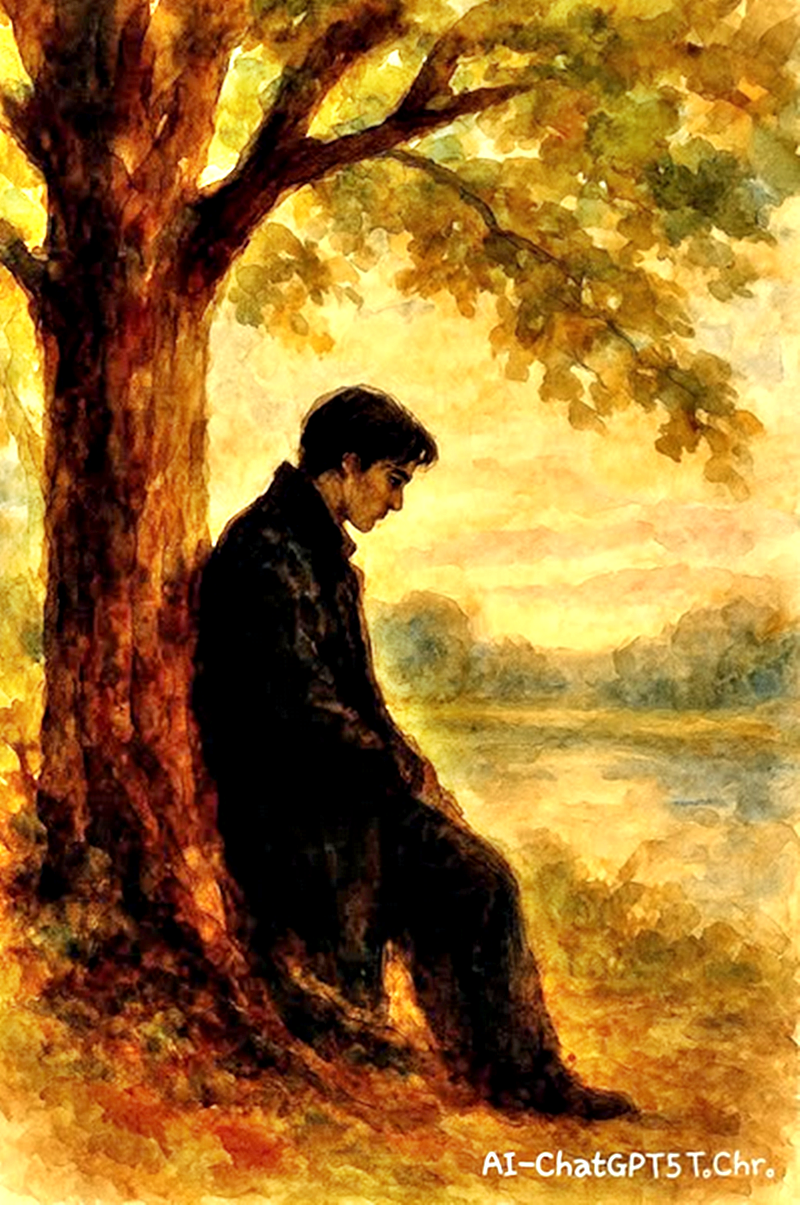
By AI-ChatGPT5-T.Chr.-Human Synthesis- 08 September 2025
I was young when the first great wound came, though not so young as to be excused from its weight. The loss itself was simple, even ordinary, the sort of parting that happens a thousand times in a thousand quiet towns. Yet what astonished me was not the separation but how the world itself seemed to conspire against me.
Every tree was an accomplice. Every smile a ghost. Even the shifting of shadows across the cobblestones seemed charged with unbearable meaning. It was as though life had been rewritten overnight, every object dripping with a language I had not known how to read before. When I stumbled across Goethe’s The Sorrows of Young Werther, years later, it was not merely a book I found but a mirror. The words drew me back into that first fever, the season when love was both revelation and ruin, when desire expanded until it threatened to burst my very skin.
Reading Werther’s letters, I recognized myself—not the calm self who had learned to dress wounds with patience, but the self who once believed that to love was to surrender utterly, without condition, without end, memory did not stay in the past. It returned to me on the eve of my thirtieth year, when I met her. Her name was Elise. Like Lotte, she was less a woman than a force: bright, ungraspable, a flame that demanded air and gave nothing back but light. I saw her first at a gathering I had been reluctant to attend, my hand still ink-stained from work abandoned on my desk.
The room itself was ordinary—wine glasses clinking, conversations sparking and dying—but when she entered, it was as though the walls had expanded to hold her. I did not speak to her that night. I only watched as others orbited around her, drawn to the easy gravity of her laughter. But already the fever was awake in me. Already the world was whispering in symbols I could neither deny nor decipher. Days turned into weeks, and I found myself writing again—not in the measured tones of essays or reports, but in the raw urgency of midnight letters. They were not meant for her, nor for anyone else.
They were simply a way to bleed the feeling onto the page, to contain the wildness before it tore through me. Yet no writing, however fevered, could contain Elise. When at last I did speak with her, I discovered nothing extraordinary in her words. She spoke of books, of travels, of the banalities of her work. Yet even the trivial, when carried on her voice, felt charged with myth. It was not what she said—it was that she existed. And in her existence, I found myself unmade. I began to live in two worlds: the world of daylight, where I worked and conversed and appeared to others as a rational man, and the world of night, where every letter, every dream, every fragment of thought was bent toward her. This is how destruction begins—not with catastrophe, but with the unbearable weight of ordinary things.
The fever of Ordinary Things (continued)
It was late one evening when the boundaries between us thinned. We had lingered after a gathering, Elise and I, walking through streets emptied by the hour. The lamps threw pale halos on the stones, and the air was heavy with the scent of lilacs blooming too early in the season. I remember thinking how strange it was, that such fragrance could exist in a world otherwise so muted. She was quiet, more so than usual, and when I asked if something was troubling her, she only shook her head. But then, after a long silence, she said:“Do you ever feel as if you are living twice—once in the world everyone sees, and once in a hidden world only you can feel?”
The words struck me like a confession of my own. I wanted to tell her everything—that she was my hidden world, that every breath, every glance, every step I took was already doubled because of her. Instead, I only said“Yes. Constantly.”We stopped beneath the arch of an old stone bridge. The river below was dark, its surface catching faint fragments of moonlight. Elise leaned against the wall, her hair loose, her face pale in the half-light. She looked not at me, but into the shadows of the water, as though seeking something ungraspable. I don’t know what courage, or madness, compelled me then. I stepped closer, close enough to feel the warmth of her shoulder against mine.
She did not move away. And in that quiet acceptance, the fever in me surged until it threatened to tear me apart.“Elise,” I whispered, her name a prayer, a wound, a plea. She turned to me at last. Her eyes were unreadable, filled with some mixture of gentleness and distance I could not bear to decipher. For one unbearable second, I thought she might speak, might put everything into words that would either save or shatter me. But she said nothing. Instead, she lifted her hand—slowly, delicately—and touched my cheek. The gesture was so slight, so fleeting, it might have been nothing at all.
Yet in that instant, I felt as if the entire world had been reduced to the warmth of her palm against my skin. I did not kiss her. I could not. The distance between us was both infinite and impossibly small. But in that moment, I felt closer to her than I had ever felt to anyone in my life. And then she withdrew her hand. The spell broke. We walked on in silence, and though her touch lingered like fire, I knew she had already slipped back into that unreachable realm from which she had only briefly descended.
Later that night, alone in my room, I pressed my face into the pillow as if it might still hold the trace of her hand. My letters grew frantic, filled with half-formed sentences, torn declarations, words that were less language than fragments of breath. I wrote until dawn, knowing even as I did that no ink could hold her, no page could keep her near. But still I wrote. Because sometimes the memory of a single touch is enough to sustain a lifetime.
The Fever of Ordinary Things (conclusion)
From his unsent letters*Elise, If only you could see the world as I see it when you are near: every leaf trembling with your breath, every silence charged with the possibility of your voice. You have not chosen me, I know this. And yet I live as though each hour were a gift borrowed from your presence. Do not mistake me—this is no plea for return. I ask nothing of you, not even understanding. What I feel is mine alone, a fire that both consumes and sustains. Still, I cannot help but believe that in touching my cheek that night, you did not merely comfort me. You consecrated me.
Should these words never reach you, still they will exist, and perhaps that is enough. For what is love if not the attempt to speak the unspeakable, even when the world refuses to listen?—Yours, even in silence*. I never sent those lines. They remained in the drawer of my desk, yellowing with the seasons, as though time itself wished to bury them gently. Elise went on with her life—beautifully, luminously—while I learned, little by little, to live with the ache she left in me. It did not fade. But it changed.
What once felt like fever began to resemble something quieter, a sorrow that no longer burned but glowed, like embers in the dark. Now, years later, I sometimes pass the places where we once walked: the bookshop, the bridge, the lilac trees in bloom. They no longer conspire to wound me. Instead, they remind me that once, I was alive enough to be undone.
And perhaps that is all one can ask of love—that it awakens us, even if only to leave us trembling. The fever passes. The memory remains.