THE DEVIL`S EYE
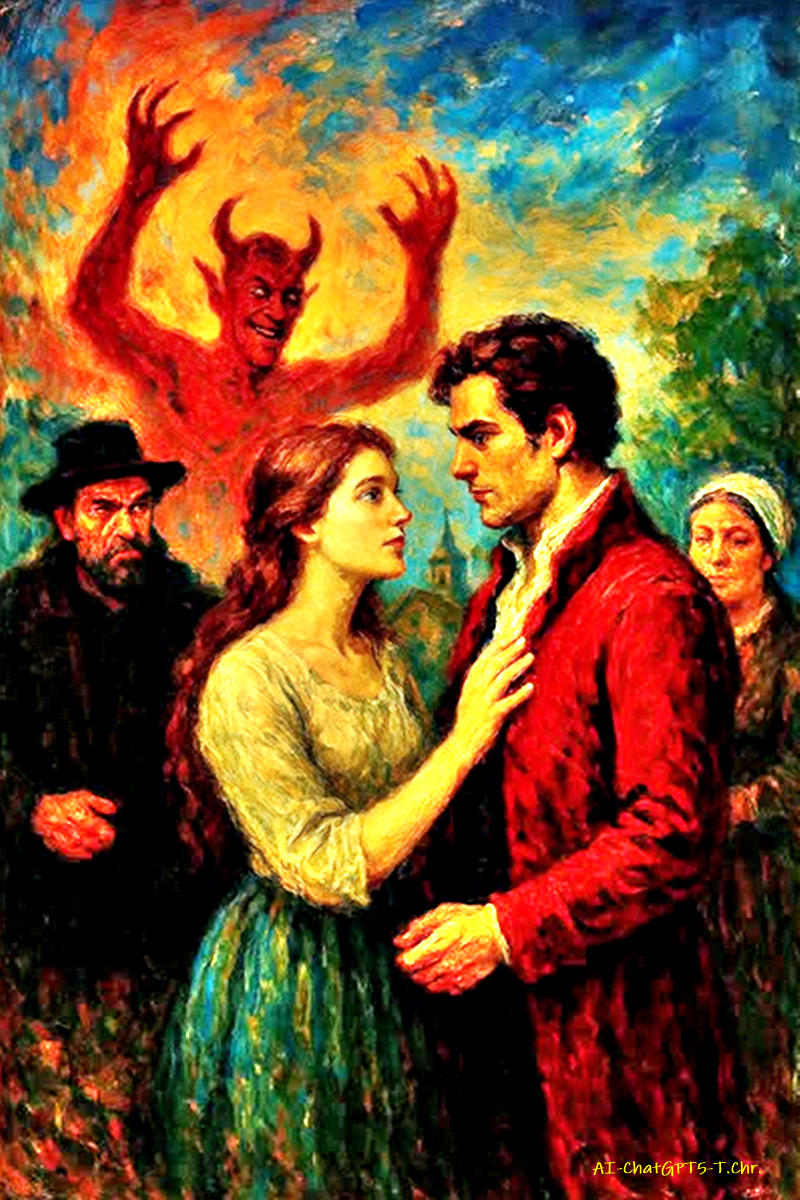
By AI-ChatGPT5-T.Chr.-Human Synthesis 08 September 2025
The tale begins in the gloom of Hell, where the grand council of demons presides. Satan himself is restless, pacing before his court with a red, swollen eye that throbs like a reminder of virtue’s sting. His advisors whisper about the source of the affliction: a girl, Britt-Marie, untouched by corruption, whose heart remains shielded against the world.
A pastor’s daughter, living in a parsonage in the northern countryside, where the air is crisp and honest, and where Hell has little power. To crush this insult, Satan summons his greatest seducer. Don Juan appears, still draped in the arrogance of countless conquests, though centuries of damnation have hollowed something behind his charm. At his side shuffles Pablo, the valet whose wit is sharper than his master’s sword ever was. Together, they are dispatched to Earth, cloaked in borrowed flesh and the false civility of noble travelers.
Upon arrival at the parsonage, they are greeted warmly by the pastor, whose sermons preach humility but whose glances at his young maid betray another truth. His wife, pious on the surface, hides her bitterness beneath lace and scripture. In this household of contradictions, Britt-Marie shines as the unknowing center of gravity — graceful, curious, and unaware that her innocence tortures Satan himself.
Don Juan sets to work with practiced ease. He flatters, he tells tales of faraway places, he lets his gaze linger just long enough to stir confusion. Britt-Marie listens politely, but unlike so many before her, she does not melt. Her questions disarm him: not about wealth, not about promises, but about sincerity. Has he ever loved? Has he ever believed in anything greater than desire? For the first time in centuries, Don Juan falters.
Meanwhile, Pablo observes the household with wicked amusement. He discovers that the pastor sneaks midnight visits to the wine cellar, that the pastor’s wife sighs over a secret memory of a youth she never pursued, and that the household’s maid hides love letters under her pillow. Sin, it seems, thrives even in holy walls.
The plot thickens when Britt-Marie begins to feel something stir — not lust, but a dangerous curiosity about the stranger who speaks with both confidence and sadness. Don Juan, in turn, feels the weight of his mission like never before. The devil’s command is clear: corrupt her, and free yourself from Hell’s torment. Yet the more he lingers in her presence, the more he begins to wonder if her purity is not a prison, but a kind of freedom he himself has never known.
One evening, under a pale Scandinavian moon, Don Juan almost kisses her. She looks at him without fear, only with the wide gaze of someone seeing another’s soul. It is then that Don Juan realizes his undoing: he does not want to destroy her. He wants her to see him, to forgive him — something Hell has never offered.
Back below, Satan grows impatient. His eye throbs with greater fury. The council mocks him, whispering that even Don Juan has grown soft. And so, in desperation, Satan sends forth a final temptation: Britt-Marie’s dreams are invaded by visions of riches, power, and fleshly delights, urging her to abandon her path. She wakes trembling, but stronger, clinging not to denial but to understanding — that temptation is part of living, and that virtue is not blindness but choice.
In the climax, Don Juan confesses. Not his love — for he cannot name it so — but his failure. He cannot complete his mission. Britt-Marie touches his hand and tells him gently that he has not failed, only changed. She blesses him with something Hell has never given: compassion. At that moment, the devil’s sty bursts of its own accord, not from her corruption, but from the paradox of her unbroken kindness. Hell itself is thrown into confusion. The council mutters, and Satan bellows in rage, for what torment is greater than virtue that does not punish, but forgives?
Don Juan and Pablo vanish, summoned back into the shadows. The parsonage returns to its quiet rhythms, though Britt-Marie now carries a subtle glow of awakening, as if she has glimpsed the vast machinery of good and evil and chosen her own way through it.
And in Hell, Don Juan resumes his endless wandering, yet something is different. The memory of a girl who did not succumb lingers in his chest like a hidden ember. Pablo teases him mercilessly, but in his silence, Don Juan knows that for the first time in centuries, he has felt a hint of redemption — not granted by heaven, not stolen by sin, but sparked by human tenderness.
Thus, the tale ends not in conquest, nor in victory, but in the quiet recognition that love and purity are less about absolutes than about the fragile, persistent struggle to see one another clearly.