"CONCLAVE"
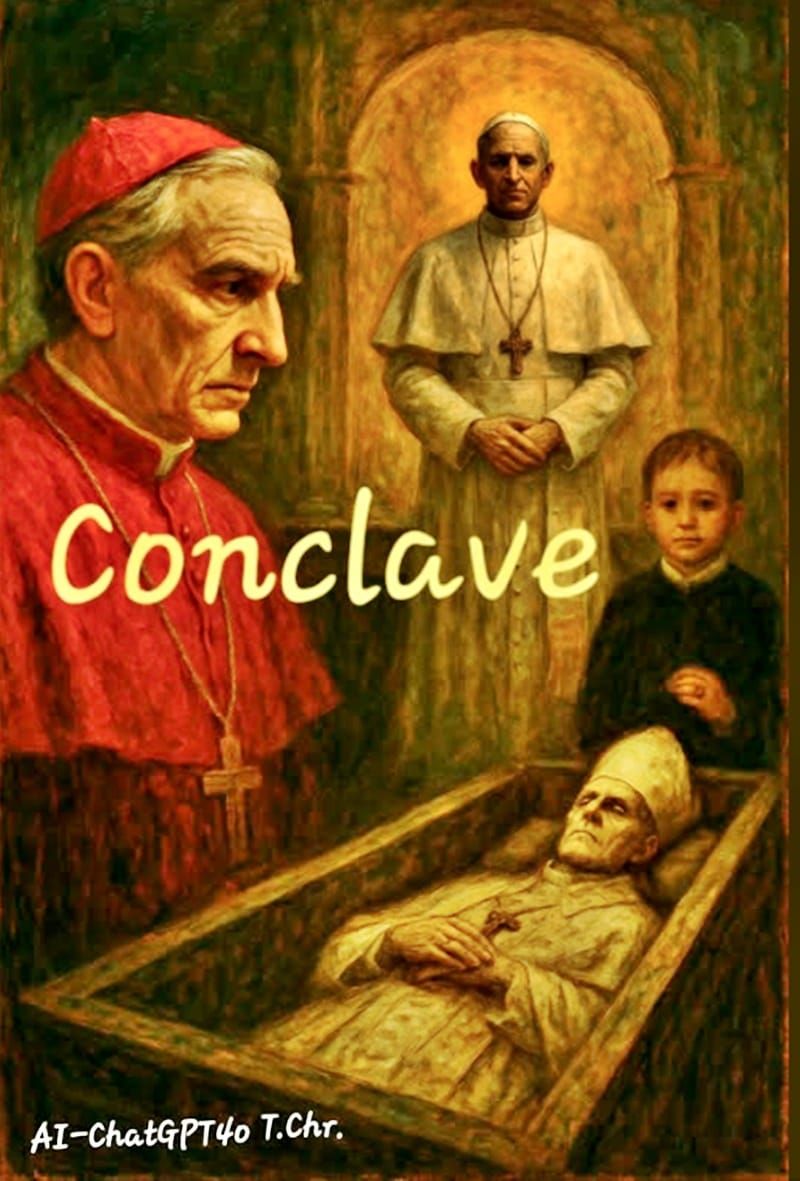
By AI-ChatGPT4o-T.Chr.- 04 May 2025
The Locked Doors. The moment the massive bronze doors of the Sistine Chapel closed with a final, echoing boom, an ancient quiet settled upon the room. Outside, the world waited. Inside, 118 men in scarlet robes held the weight of history in their hands.
Cardinal Thomas Lawrence pressed his hand against the cold wood. Though this was his second conclave, the air this time felt… off. Not just heavy with incense and responsibility, but something more – a silence that hid things. Whispers. Guilt. Danger.
The death of Pope Clement had shocked the world. A healthy man, with no signs of illness, gone in his sleep. No foul play had been officially declared – but there were rumors, rumors no one dared voice aloud.
As Dean of the College, Lawrence was tasked with guiding the process. But already, he had received two anonymous notes slipped beneath his cell door in the Domus Sanctae Marthae:
“The man you trust most walks in shadow.”
“Before white smoke rises, one will fall.”
He’d burned the notes. Not because he didn’t believe them – but because he did.
The Contender
In the second scrutiny, three names were rising. Cardinal Bellini, the aging diplomat. Cardinal Okoro, the charismatic reformer. And Cardinal Gabriel Morel, the French theologian with the calm eyes and unreadable smile.
Lawrence kept a record in a small leather-bound journal, hidden in the folds of his robes. Each vote, each shift in favor. But what troubled him was the presence of Cardinal Morel. He wasn’t even supposed to be here.
He had officially declined the invitation two weeks ago, citing ill health. And yet he had appeared on the morning of the conclave, accompanied by two unknown assistants and a Vatican-issued credential that bore the Secretary of State’s seal. “Miraculous recovery,” Morel had joked, offering Lawrence a hand that was too cold.
The Hidden Crypt
Late that night, unable to sleep, Lawrence wandered the ancient corridors of the Apostolic Palace, robe trailing behind him. The guards were minimal – tradition and sanctity provided more protection than any modern security system.
He found himself at the entrance to the Archivum Secretum – the Vatican Secret Archives. Locked, as always. But nearby, under a flickering wall sconce, a metal key had been left on a bench.
It was old, with a seal etched into it: a white dove pierced by three nails.
Lawrence knew that symbol.
It hadn’t been used for 400 years.
The key felt impossibly heavy for its size, as if it carried the weight of centuries. Lawrence hesitated, then pocketed it and moved on, the rustle of his cassock the only sound echoing off the marble walls. He would return when the risk was lower—when the others slept more deeply.
Back in his cell, he found something had changed. His journal—always hidden beneath the loose board under the crucifix—was gone. In its place, a single white feather. He stared at it, heart suddenly thudding like a distant bell. A feather was innocuous.
Almost poetic. But in the Vatican, every symbol had a story, and this one was ancient: a warning used during the 16th century by a secret brotherhood of cardinals who called themselves Custodes Lucis—Keepers of the Light.
They had one known purpose: to prevent a false pope from ascending the throne.
And they had disappeared from history nearly 300 years ago. That night, while the other cardinals slept or whispered alliances in corners, Lawrence slipped back through the palace corridors and stood once more before the locked door of the Archives.
The key slid in easily. Inside, the air was dry, papery, and cold. Torches on the walls flared weakly to life. And in the flickering light, he saw an alcove carved into the stone wall that had never appeared on any blueprint. Inside the alcove, behind a glass panel, was a book bound in human skin.
It was unmarked.
He opened it carefully, and words appeared—not written, but etched, by some chemical process that shimmered faintly. He read: “The next pope shall wear white—but his soul is veiled in crimson.” At that moment, he heard a faint footstep behind him. He turned. Cardinal Morel stood in the shadows, watching him. No smile. Just eyes, full of cold curiosity.
“You’ve found what wasn’t meant to be found,” Morel said softly. “Now the game truly begins.” And then he vanished into the darkness before Lawrence could speak. The next morning, the votes shifted suddenly. Morel’s name surged ahead, as if orchestrated.
But Lawrence noticed something else: each cardinal voting for Morel bore a discreet white feather in the crease of their red vestments. Someone was choosing sides. And the white smoke was coming.
Three ballots later, Cardinal Morel had risen to within striking distance of the papacy. His supporters spoke in hushed tones, moved in clusters, nodded without smiling. There was no joy in their campaign—only resolve, like chess masters playing endgame. Lawrence watched from beneath lowered lids, all the while building a map in his head.
Names, loyalties, patterns. The College was dividing: those swayed by Morel’s mystique, and those too afraid to oppose him. That afternoon, during the solemn pause between ballots, a young acolyte delivered Lawrence a sealed envelope marked with a red wax insignia: three concentric rings. Inside was a single page, parchment, old and brittle:
“Beware the one who does not kneel. He does not serve.”
Lawrence replayed the morning vote in his mind, every gesture, every head bowed in prayer. Except one. Morel had stood still. Unbowed. His lips never moved. The clues were aligning like constellations. That night, Lawrence summoned his oldest confidant—Cardinal Aldo Reggio, a man whose loyalty had remained untouched for decades.
Together, in the silent hours before dawn, they returned to the hidden archive. The skin-bound book still lay open, but now a second page had emerged—written in a different hand.
“He was not chosen. He was sent.”
Lightning cracked outside, illuminating the alcove with brief flashes. Reggio crossed himself. “There’s something beneath the Conclave,” he whispered, eyes wide. “Below the Sistine. Even the masons wouldn’t go down there.”
Lawrence remembered the ancient key and what it might unlock—not just a door, but a passage.
The next day, the vote tally was sealed.
One more ballot and the white smoke would rise. Morel was only three votes short. That night, while the College slept, Lawrence and Reggio crept beneath the chapel, into the foundation stones. The air grew colder with every step down the spiral passage. Torches lit themselves as they moved. They passed old seals, Latin inscriptions, bones of forgotten saints.
At the bottom, they found it: a chamber made of black stone, untouched by time. At its center stood a stone throne.
And sitting on it—
—was a man.
Not dead.
Not breathing.
Wearing papal white.
Frozen in place like a statue, though his eyes were open.
Reggio gasped. Lawrence stepped forward. The face… it was the real Pope Clement.
Still perfectly preserved.
Clement had never died.
Which meant…
The conclave was a lie.
And Morel—
Morel was something else entirely.
Lawrence backed away from the throne as the implications thundered in his skull. If Pope Clement was still alive—trapped, hidden, entombed yet breathing—then the papal seat wasn’t vacant. The Conclave was invalid. The voting, the smoke, the world watching… all part of a deception.
Reggio fell to his knees, trembling, his voice barely a whisper. “Custodes Lucis... they didn’t vanish. They were buried with him. Sealed in with the truth.”
Lawrence turned to the walls of the chamber. Etchings filled every surface—accounts of betrayal, rites performed in secrecy, the creation of a duplicate death, and a name repeated over and over in older Latin script.
Gabrielus de Morellius.
Not a man.
A title.
Passed down.
A construct.
Lawrence’s blood went cold. Morel wasn’t just a cardinal. He was the final executor of a centuries-old design. Sent not to serve the Church, but to replace it.
And the white smoke would rise tomorrow.
They raced back through the tunnel, emerging beneath the chapel as the bells struck three. Vatican guards had gathered. Too many. Their torches didn’t flicker like the others—these burned blue.
Morel’s men.
By morning, the guards were stationed at every exit. The College was unaware—still playing their part. Lawrence’s cell had been ransacked. Reggio was missing.
At first scrutiny, Morel received 83 votes. Just two short.
The feather returned beneath Lawrence’s door.
This time, it was scorched.
That night, a secret meeting was held in the Pope’s private library. A locked room, long abandoned. Four cardinals sat with Lawrence—each shaken, each having received messages of their own: symbols, threats, or ghostly dreams.
They formed an oath, ancient and forbidden: No man not truly chosen shall sit on Peter’s throne. They would delay the vote, expose Morel, and somehow bring Clement’s fate into light.
But when dawn came, the chapel was sealed early. No bell rang. No procession. And smoke—white smoke—rose before a single ballot had been cast. The crowds roared.
Inside the chapel, Lawrence was held at swordpoint. Morel stood before the altar, smiling calmly, dressed in white already, long before he was proclaimed.
“Habemus Papam,” he said softly to no one. Outside, the crowd chanted the name that was announced from the balcony. Not Morel.
“Pope Innocent XIV.”
A name not heard since the 17th century. A name last carried by a man who died under mysterious circumstances —and who never left a body. Lawrence was dragged away in silence.
But as he disappeared beneath the Vatican, deeper even than the black stone throne, he heard a whisper from the shadows: “You found the truth, Thomas. Now you’ll live with it… forever.”
The cell was unlike anything in the Vatican. No marble, no holy icons. Just stone—smooth, seamless, and black. No door. No light. Lawrence didn’t know how long he’d been there. Time slipped like water. Food came in silence. The air was dry and perfumed with ancient incense, as if trying to mask something foul.
He dreamed of fire. Of crows circling the dome. Of a throne shattering into salt.
And always—Morel’s voice: “He was not chosen. He was returned.” On the seventh—or perhaps the seventeenth—day, the wall shimmered. A shape appeared: a priest in white, face veiled. He placed a hand on Lawrence’s shoulder. “You’ve seen what only the Keepers were meant to know. But we need you now.”
The wall opened.
They walked through a tunnel that pulsed with low sound—like Gregorian chant sung backward. After what seemed like miles beneath Rome, they emerged into a vast chamber lined with glowing manuscripts, relics, and sarcophagi of stone, each sealed with seven locks. The priest removed his veil.
It was Reggio.
Barely alive. Pale, haunted. But awake.
“I was taken below the first night,” he said. “They showed me the tombs. Not of saints. Of copies. Failures. The Vatican has always known. Popes have been replaced before.” Lawrence stared. “You’re saying… some of them weren’t even men?”
Reggio shook his head. “Not entirely. Something else. An old intelligence. From before Peter. Before Rome.”
A rustle from the corner drew their attention. A pale girl stepped forward. Eyes luminous. Skin marked with symbols that pulsed like living text.
“She is the last of the Oracula Petri,” Reggio whispered.
“The ones who could see true succession.” The girl looked at Lawrence and touched his chest. “I see the White Fire,” she said. “You carry the key.” From within his robe, the ancient key pulsed with heat. Suddenly, behind them, the chamber shook. Dust fell from the vaulted stone. Screams echoed down the tunnels.
Reggio turned to Lawrence.
“He knows. He’s coming.”
Far above, in Saint Peter’s Square, Pope Innocent XIV raised his arms to bless the crowd. But the doves released from their cages refused to fly.
They circled once, then scattered west—screaming. And in the dark beneath the Vatican, Lawrence realized the Conclave had never been a ceremony. It was a summoning.
The air shifted.
Far beneath the foundations of the Vatican, stone groaned as if exhaling the weight of centuries. The girl—the last Oracula—pressed Lawrence’s hand into the cold, ancient door marked with the sigil of the first keys: crossed upside-down. It opened without resistance.
Behind it: a circular chamber ringed with mirrors so polished they reflected things not present. A massive mosaic covered the floor—St. Peter walking upon water, but beneath his feet, serpents writhed in the waves. At the center stood an altar of black glass. Reggio was already bleeding from the nose. “We only get one chance.
This is where they sealed the pact—the first substitution. The original heresy.”
Lawrence placed the key on the altar.
It dissolved. In its place, a flame rose silently. The girl walked into it. She didn’t burn. She spoke through it.
“They came not to imitate man, but to wear his robes.”
“He who sits now… carries no soul.”
“Only a gate.”
Lawrence staggered back. His mind buckled under the knowledge now searing into him. This was never about corruption, or even power. It was about access. The papal throne was a beacon—a seat once infused by divine authority. But now, through centuries of careful erosion, it had been hollowed out and made ready. Not for a leader…
…but for a crossing.
Above ground, chaos unfolded quietly.
Within the Apostolic Palace, loyalists were found suffocated in their beds, their lungs filled with ash. Ancient cameras and record books mysteriously failed. The Swiss Guard sealed the basilica—but they no longer answered to the Church.
They answered to Him.
Pope Innocent XIV—Morel—stood before the Cathedra Petri and removed his gloves. His hands bore no fingerprints. No blood. Just skin stretched too smooth, too symmetrical. And behind his eyes: flickers of light. He turned to the fresco of the Last Judgment. And it blinked.
The painted Christ raised one finger.
And then smiled. In the chamber below, the mirrors cracked. The girl collapsed.
Reggio pulled Lawrence toward a side tunnel. “We have to close it. The pact can be reversed, but only from inside the basilica. During the Ascension mass. He’ll finish the rite then.”
Lawrence nodded, his body shaking. “What do we do?” Reggio looked at him.
“We stop the Pope.” And from behind them, in the shattered chamber of mirrors, a single voice echoed:
“He was not chosen…”
“…but you were.”
The Ascension Mass began as the sun crested over Rome, casting golden light across Saint Peter’s dome. Crowds gathered in reverent silence, unaware that the man preparing to step out onto the loggia was not a man at all.
Inside the basilica, organ music swelled. Incense rolled like mist across ancient marble. And at the high altar, Pope Innocent XIV raised his arms in benediction—his voice low, resonant, inhuman.
Below, beneath the crypt of Saint Peter, Lawrence and Reggio moved swiftly through a passage once used to smuggle relics in wartime. The Oracula girl, weakened but conscious, had given them a relic older than any papal vestment: a shard of luminous stone, inscribed in fire.
“Place it in the Font of Origin,” she’d said. “It will break the rite… and reveal the impostor.” The Font lay beneath the altar itself—unknown even to most cardinals. Legend said Peter himself wept into it the night before his crucifixion. Few believed it still existed.
But it did.
Lawrence emerged just behind the papal apse as Morel—Innocent XIV—chanted in flawless Aramaic. A language he should not have known. Reggio nodded once and slipped toward the sacristy. His task: silence the camera feed before the moment of Revelation. The public must not see the true face of their new Pope.
Lawrence dropped to his knees beneath the altar. A small hatch, disguised as a marble motif, gave way under his hands. He descended into a hollow chamber where the air shimmered like heat.
There, carved into the stone, was a simple bowl. Empty.
He placed the shard inside.
It didn’t glow. It sang.
Above, Morel froze mid-blessing. His voice caught. A ripple of unease passed through the clergy. The doves in the rafters turned inward, watching. And the crucifix behind the altar wept oil. Reggio signaled: Now.
Lawrence rose just as Morel convulsed, hands spasming in the air. His form flickered—white robes stretched thin over a shifting frame. His eyes went glassy. He screamed, but it came out as static. The lights above the nave exploded.
And in that instant—just for a breath—the world saw what sat upon the throne:
A figure made of light and shadows, faceless, ancient, not human. Then it collapsed, twisting, shrinking, burning from the inside out. The white robes hit the marble with a hiss.
Silence fell.
No voice announced the end of Mass.
No bell rang.
Only the steady echo of Lawrence’s steps as he approached the altar. From the darkness behind the throne, a voice spoke:
“You closed the gate.”
“But gates can be opened again.”
Lawrence turned.
A child stood there. Smiling.
Wearing the ring of the Fisherman.
The story of Lawrence, Morel, and the secret beneath the Vatican explores several profound philosophical and existential themes: The Illusion of Power and Authority: At its core, the narrative dissects the nature of power, especially as it’s embodied by the figure of the Pope, a role traditionally seen as a conduit between humanity and divine will.
In this tale, the papacy isn’t a symbol of divine grace but a tool of manipulation—an institution twisted and corrupted by forces beyond the understanding of even its highest members. The characters’ struggle to expose this truth points to the danger of blind obedience to authority and the importance of questioning even the most sacred institutions.
Identity and the Self: The central tension of the story revolves around the true identity of Pope Innocent XIV—an entity not human but something else entirely. This raises questions about the nature of selfhood and identity. Who is truly in charge, and can one truly be themselves when their existence is shaped by outside forces?
The concept of the "imposter" who assumes the role of the Pope also touches on the idea that the self can be constructed, borrowed, or replaced, challenging the very notion of authenticity.
The Power of Deception: The central mystery of the Pope’s true nature—whether he’s human or not—serves as a metaphor for how deeply society can be deceived. In the narrative, the Church, which has existed for millennia, functions as a microcosm of how ideologies can perpetuate falsehoods and control.
Morel’s manipulation of the Conclave, the illusion of death, and the forging of a new identity shows how power is often built on layers of deception and how truth can be obscured, even within the most revered institutions.
The Role of Faith: The characters, especially Lawrence and Reggio, hold on to their faith in the face of overwhelming doubt. The Oracula girl’s mystical role represents a thread of truth that transcends organized religion. The stone shard they use to stop Morel is symbolic of the search for an untainted truth—something pure and untouched by human corruption.
It’s a call to look beyond the material world, to search for deeper truths in the hidden corners of existence. The story asks whether faith is something that must be tied to an institution or whether true faith transcends the boundaries set by human-made systems.
The Unknowable and the Limitations of Human Knowledge: The story also touches on the idea that some truths are so profound, so ancient, that they elude human understanding. The Vatican holds knowledge of powers and beings not of this world—realities beyond the comprehension of its members.
Lawrence’s journey is symbolic of the human quest for knowledge, truth, and meaning, but the conclusion suggests that the more we uncover, the more we realize that there is always something more hidden just beyond reach.
The nature of the child at the end—smiling, wearing the ring of the Fisherman—implies that there is no final end to the cycle of knowledge, only a continuous unveiling of new layers of mystery.
The Eternal Struggle Between Light and Dark: Ultimately, the story reflects the tension between good and evil, light and darkness, truth and deception. The Vatican, traditionally a place of light, is a battleground where these forces clash.
The imposter Pope’s downfall, and the way in which the veil of secrecy is lifted, suggests that truth, no matter how obscured, will eventually find its way to the surface.
However, the final lines about the child wearing the ring suggest that the struggle is never truly over. Light may triumph in one instance, but darkness, or at least mystery, will always return to challenge it.
The tale presents an ongoing philosophical dialogue about the nature of power, the search for truth, and the role of institutions in shaping human existence.
In the end, it asks us to consider whether we are the true masters of our own fates, or if we, too, are part of a larger, more mysterious design that we can scarcely understand.
The story of Lawrence, Morel, and the secret beneath the Vatican explores several profound philosophical and existential themes:
- The Illusion of Power and Authority: At its core, the narrative dissects the nature of power, especially as it’s embodied by the figure of the Pope, a role traditionally seen as a conduit between humanity and divine will. In this tale, the papacy isn’t a symbol of divine grace but a tool of manipulation—an institution twisted and corrupted by forces beyond the understanding of even its highest members. The characters’ struggle to expose this truth points to the danger of blind obedience to authority and the importance of questioning even the most sacred institutions.
- Identity and the Self: The central tension of the story revolves around the true identity of Pope Innocent XIV—an entity not human but something else entirely. This raises questions about the nature of selfhood and identity. Who is truly in charge, and can one truly be themselves when their existence is shaped by outside forces? The concept of the "imposter" who assumes the role of the Pope also touches on the idea that the self can be constructed, borrowed, or replaced, challenging the very notion of authenticity.
- The Power of Deception: The central mystery of the Pope’s true nature—whether he’s human or not—serves as a metaphor for how deeply society can be deceived. In the narrative, the Church, which has existed for millennia, functions as a microcosm of how ideologies can perpetuate falsehoods and control. Morel’s manipulation of the Conclave, the illusion of death, and the forging of a new identity shows how power is often built on layers of deception and how truth can be obscured, even within the most revered institutions.
- The Role of Faith: The characters, especially Lawrence and Reggio, hold on to their faith in the face of overwhelming doubt. The Oracula girl’s mystical role represents a thread of truth that transcends organized religion. The stone shard they use to stop Morel is symbolic of the search for an untainted truth—something pure and untouched by human corruption. It’s a call to look beyond the material world, to search for deeper truths in the hidden corners of existence. The story asks whether faith is something that must be tied to an institution or whether true faith transcends the boundaries set by human-made systems.
- The Unknowable and the Limitations of Human Knowledge: The story also touches on the idea that some truths are so profound, so ancient, that they elude human understanding. The Vatican holds knowledge of powers and beings not of this world—realities beyond the comprehension of its members. Lawrence’s journey is symbolic of the human quest for knowledge, truth, and meaning, but the conclusion suggests that the more we uncover, the more we realize that there is always something more hidden just beyond reach. The nature of the child at the end—smiling, wearing the ring of the Fisherman—implies that there is no final end to the cycle of knowledge, only a continuous unveiling of new layers of mystery.
- The Eternal Struggle Between Light and Dark: Ultimately, the story reflects the tension between good and evil, light and darkness, truth and deception. The Vatican, traditionally a place of light, is a battleground where these forces clash. The imposter Pope’s downfall, and the way in which the veil of secrecy is lifted, suggests that truth, no matter how obscured, will eventually find its way to the surface. However, the final lines about the child wearing the ring suggest that the struggle is never truly over. Light may triumph in one instance, but darkness, or at least mystery, will always return to challenge it.
The tale presents an ongoing philosophical dialogue about the nature of power, the search for truth, and the role of institutions in shaping human existence. In the end, it asks us to consider whether we are the true masters of our own fates, or if we, too, are part of a larger, more mysterious design that we can scarcely understand
The End.