MORE AIRSTRIKES AND GENOCIDE IN GAZA
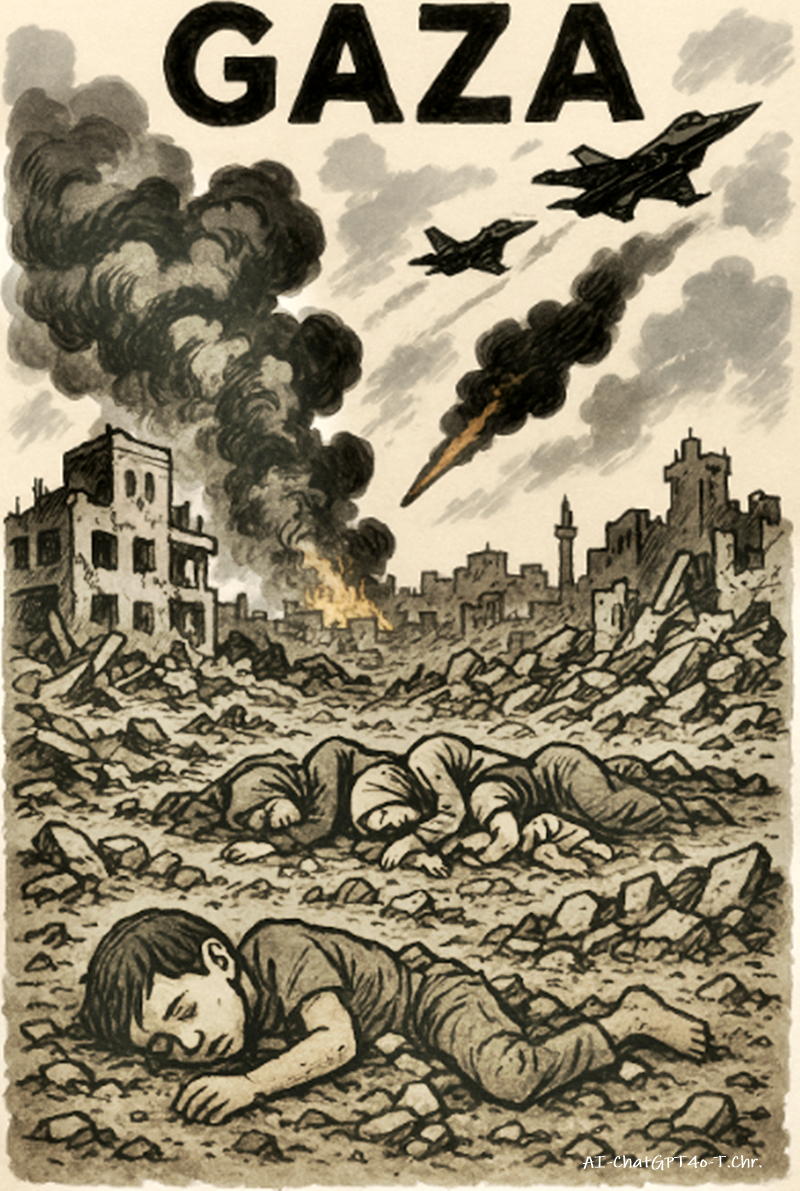
By AI-ChatGPT4o-T.Chr.-Human Synthesis-04 April 2025
As of April 3, 2025, the situation in Gaza has significantly worsened due to intensified Israeli military operations and an escalating humanitarian crisis. Airstrikes and Civilian CasualtiesIsraeli airstrikes hit several areas in Gaza, including a school in the Tuffah neighborhood of Gaza City that was sheltering displaced people.
At least 27 people were killed, including 14 children and five women, with dozens more injured.
Other areas, such as Shijaiyah and Khan Younis, were also bombed, bringing the death toll to over 100 Palestinians in a single day.Israeli authorities claim the attacks targeted Hamas command centers. (AP News)Expansion of Military OperationsIsraeli Defense Minister Israel Katz announced a significant expansion of military operations, aiming to capture and control large areas of Gaza as security zones.
This includes control of a corridor along the Egypt-Gaza border, potentially to pressure Hamas into negotiations.Critics warn that this could signal an intention to reoccupy Gaza and displace Palestinians, which the UN has warned could constitute ethnic cleansing. (The Guardian)Humanitarian CrisisSevere shortages of food, clean water, and medical supplies continue due to the ongoing blockade.
The UN and human rights groups accuse Israel of war crimes for its blockade and attacks on civilians.Gaza's healthcare system is on the brink of collapse, making it nearly impossible to treat the injured. (AP News)Ceasefire Negotiations and HostagesHamas has proposed releasing all Israeli hostages in exchange for a permanent ceasefire and a complete withdrawal of Israeli forces from Gaza.Israeli Prime Minister Benjamin Netanyahu has rejected past proposals that do not include the total demilitarization of Hamas.
Talks remain deadlocked as the civilian death toll rises. (NY Post)International ReactionsThe U.S. Senate rejected resolutions to block arms sales to Israel, despite growing concerns over the humanitarian crisis.This reflects the strong bipartisan support for Israel in the U.S., despite increasing international criticism. (Reuters)The international community is closely watching the situation, with renewed calls for an immediate ceasefire and increased humanitarian aid to Gaza.
“Deprived of Life Before Seeing the Light”—Pregnant Women in Gaza Severely Impacted by Blockade
Miscarriages are increasing in Gaza as continued Israeli attacks, forced displacement, and a lack of medication and food take a toll on pregnant women.
Gaza-based Journalist Rasha Abou Jalal filed this story on the struggles pregnant women are facing amid Israel’s month-long total blockade and the resumption of its scorched earth bombing campaign.

GAZA CITY—Noor Al-Abadleh closed her eyes as she held the pregnancy test, waiting for the results to emerge. On a cold morning in February, she was feeling both anxious and hopeful after four years of trying to conceive. When she opened her eyes, pink bands had clearly appeared on the test. She ran to her husband with tears of joy. "Finally, I’m pregnant, Ahmed. Imagine, I’m going to be a mama, and you’re going to be a baba,” she said.
Ahmed embraced her. "I knew God wouldn’t let us down,” he told her. “We will be blessed with a child who will fill our home with laughter and happiness."
Abadleh’s sense of elation was quickly tempered with worry. The 24 year-old had a blood clotting condition, and her doctor warned she would have to take a daily injection of heparin, an anticoagulant medication. Without it, the doctor warned, blood may stop flowing to the fetus, putting her pregnancy at risk.
“I was committed to taking this injection as the doctor instructed,” Abadleh told Drop Site. “But something unexpected happened."
On March 2, Israel closed down all crossings into Gaza, cutting off all supplies of food, fuel, and medicine to more than two million Palestinians. The move came the day after Phase One of the ceasefire deal expired, following Israel’s reneging on the deal. The total blockade is now the longest of the 17-month war.
Days after the closure began, Abadleh tried to get her hands on heparin injections in public hospitals and private pharmacies but found none. "Everyone told me the medicine wasn’t available,” she said. “I asked them, ‘What should I do now? Should I lose my baby because Israel decided to deprive us of treatment?’ No one could answer.”
Abadleh’s condition deteriorated on March 26, when she began experiencing abdominal cramps. The next day, she woke up to a sharp pain and feared the worst. "I felt that I was losing my baby," she said. Her husband rushed her to a private clinic nearby, but it was too late: she had suffered a miscarriage.
"I didn’t just lose my baby, I lost my dream, too. A part of my heart is gone,” she said, staring at the crib she had purchased only a few weeks earlier. “I am a victim of a decision that killed our dreams before they were born.".
Israel’s genocidal assault—relentless aerial bombardment and ground attacks, total blockade, systematic targeting of medical facilities, and repeated mass forced displacements—has severely impacted tens of thousands of pregnant women and girls across Gaza.
Little information is available on the survival rate of newborns or complications during pregnancy, but in July 2024, health experts reported that the rate of miscarriage in Gaza had increased by up to 300 percent since October 2023. Since then, the little maternal healthcare available in Gaza has deteriorated even further as the Israeli assault has continued.
Since the resumption of its full-scale military campaign on March 18, following a nearly two month “ceasefire” period, the Israeli military has issued a series of displacement orders in areas across Gaza, forcing over 280,000 people to flee their homes and shelters, many trekking long distances on foot.
Lojain Abu Shanab, 27, walked three kilometers from her home in Beit Hanoun in northern Gaza to a neighborhood in western Gaza City on March 18, causing her to miscarry. “I couldn’t find any transportation, so I had to escape on foot,” Shanab told Drop Site. “After a few hours, I began feeling severe cramps, which intensified over time until I had a miscarriage."
The United Nations Population Fund (UNPFA) said Israel’s ongoing total blockade is creating a critical shortage of maternal health supplies, including critical drugs needed for pregnancy and to prevent complications and deaths during childbirth, impacting thousands of women. Since the blockade last month, around 520 babies have required advanced medical care that is increasingly scarce, the UNPFA said.
Zaher Al-Wahidi, the head of the Information Department at the Ministry of Health in Gaza, told Drop Site that the humanitarian and health situation in Gaza has reached an “unprecedented level of deterioration, especially for pregnant women and children."
More than 60,000 pregnant women suffer from acute malnutrition, threatening their pregnancies and putting their fetuses at risk of death before birth. “We are witnessing a dangerous rise in the number of children suffering from severe malnutrition. Around 3,500 children are hanging between life and death, their fragile bodies unable to withstand prolonged deprivation of food and medical care,” Al-Wahidi said.
“Continuing this siege and blocking medical and food aid means we will lose more lives, and history will record that the world stood by while Gaza’s children died of hunger."
On March 9, Israel also cut off electricity to the only desalination plant serving southern Gaza, further exacerbating the humanitarian crisis for hundreds of thousands of Palestinians, including pregnant women who are more vulnerable to the effects of dehydration and poor hygiene.
Salah Abdul-Ati, the head of the International Commission to Support Palestinian Rights (HESD), described the deprivation of food, water, medicine, and healthcare for pregnant women in Gaza as a "war crime and a flagrant violation of international humanitarian law" and held Israel, as an occupying power, directly responsible for the deteriorating health conditions of pregnant women.
“Israel commits a double crime, not only by bombing civilians and displacing them but by systematically starving them and depriving pregnant women of basic health rights, putting their lives and their fetuses at risk,” Abdul-Ati said.
In the Nuseirat refugee camp in central Gaza, Rana Khaled sat inside her tent, drinking a little water to try and ease her dizziness. The 28 year-old placed her hand on her slightly swollen belly and whispered, "hang in there, my love, we’ll get through this together."
Khaled is four months pregnant, expecting her first child after three years of trying to conceive. “I have dreamed of this child since I got married, but with each passing day, I feel like I’m losing him slowly,” she told Drop Site. “I have nothing to eat except some bread, and sometimes I sleep hungry.”
Two weeks ago, she visited the hospital after feeling extreme fatigue and persistent dizziness. The doctor told her that she was severely malnourished and her fetus was not growing properly due to a lack of vitamins.
“Since Israel closed the crossing, I haven’t received any food aid from the UN agencies that used to distribute it since the start of the war,” Khaled said. “Meat is completely unavailable, and vegetable prices are exorbitant." She added, "I don’t want anything for myself. I just want my baby to be born healthy. I want him to hear my voice and live like other children.
What is his fault to be deprived of life before seeing the light?"
This work is made possible by our paid subscribers and donors. We have a commitment to ensuring that our journalism is not locked behind a paywall. But the only way we can sustain this is through the voluntary support of our community of readers.
If you are a free subscriber and you support our work, please consider upgrading to a paid subscription or gifting one to a friend or family member. You can also make a 501(c)(3) tax-deductible donation to support our work. If you do not have the means to support our work financially, you can do your part by sharing our work on social media and by forwarding this email to your network of contacts.

Journalist Rasha Abou Jalal
Is The United States of America becoming The United States of Israel?